University career teams are evaluating AI mock interview platforms for a different reason than individual job seekers. The buyer is not only choosing a practice experience. The institution must also evaluate administration, student access, privacy, accessibility, integration, implementation, and evidence that students actually use the tool.
The short answer
The best AI mock interview platform for a university is the one students can access repeatedly, career staff can administer without creating another manual workflow, and procurement can approve for privacy and accessibility. Prentus is the strongest fit when a university wants live voice practice, job-specific questions, adaptive follow-ups, advisor review, and interview analytics inside a broader career platform. Big Interview is a strong dedicated training option with structured learning content. Quinncia stands out when resume review and interview practice need to work together. VMock is a logical shortlist choice when benchmarked resume feedback is the primary need and interview practice is an extension. No ranking can replace a scenario-based pilot. Institutions should test the same student tasks, accommodations, reporting requests, and implementation questions with every finalist before selecting a vendor.
This guide focuses on institutional fit. Students looking for individual practice can use a different buying process. Career services leaders should start with how the platform will support the whole student population and how it fits the team's existing workflow.
Practice format is the biggest functional difference in this category, and it is worth evaluating before any other feature. Big Interview, Quinncia, and VMock have students record a one-way answer to a preset question, then return a score or review on that recording. Prentus runs a real-time, two-way voice conversation: the AI asks adaptive follow-up questions based on what the student actually says, closer to how a real interview unfolds, and still records the session for advisor review afterward.
How we selected and ranked the platforms
We reviewed public product information and existing Prentus product documentation. We ranked products for a university career-services procurement, not for consumer popularity. The criteria were:
- Practice quality: spoken or recorded practice, question relevance, and repeatability.
- Feedback: clear guidance students can use in the next attempt.
- Institutional administration: staff visibility, reporting, and scalable access.
- Procurement readiness: the ability to evaluate security, accessibility, integrations, and implementation.
- Scope fit: whether the product is a focused interview tool or part of a broader career platform.
Editorial disclosure: Prentus publishes this guide and is ranked first. To keep the comparison useful, every vendor receives a clear best-fit use case and a limitation. Feature availability and contract terms can change, so confirm requirements with each vendor during procurement.
AI mock interview platform comparison
| Platform | Best fit | Practice format | Institutional view |
|---|---|---|---|
| #1 Prentus | institution-wide interview practice connected to career services workflows | Live voice conversations with adaptive follow-up questions | Participation and performance analytics for career teams |
| #2 Big Interview | structured interview curriculum and dedicated practice | Recorded mock interview practice with an interview-training curriculum | Institutional access and career-center deployment |
| #3 Quinncia | connecting resume review with interview practice | Video-based practice informed by the student resume | Institutional deployment for resume and interview preparation |
| #4 VMock | institutions prioritizing resume scoring with interview practice | Career-track mock interview practice with video analysis | Institutional career-readiness deployment |
#1 Best for institution-wide interview practice connected to career services workflows
Prentus
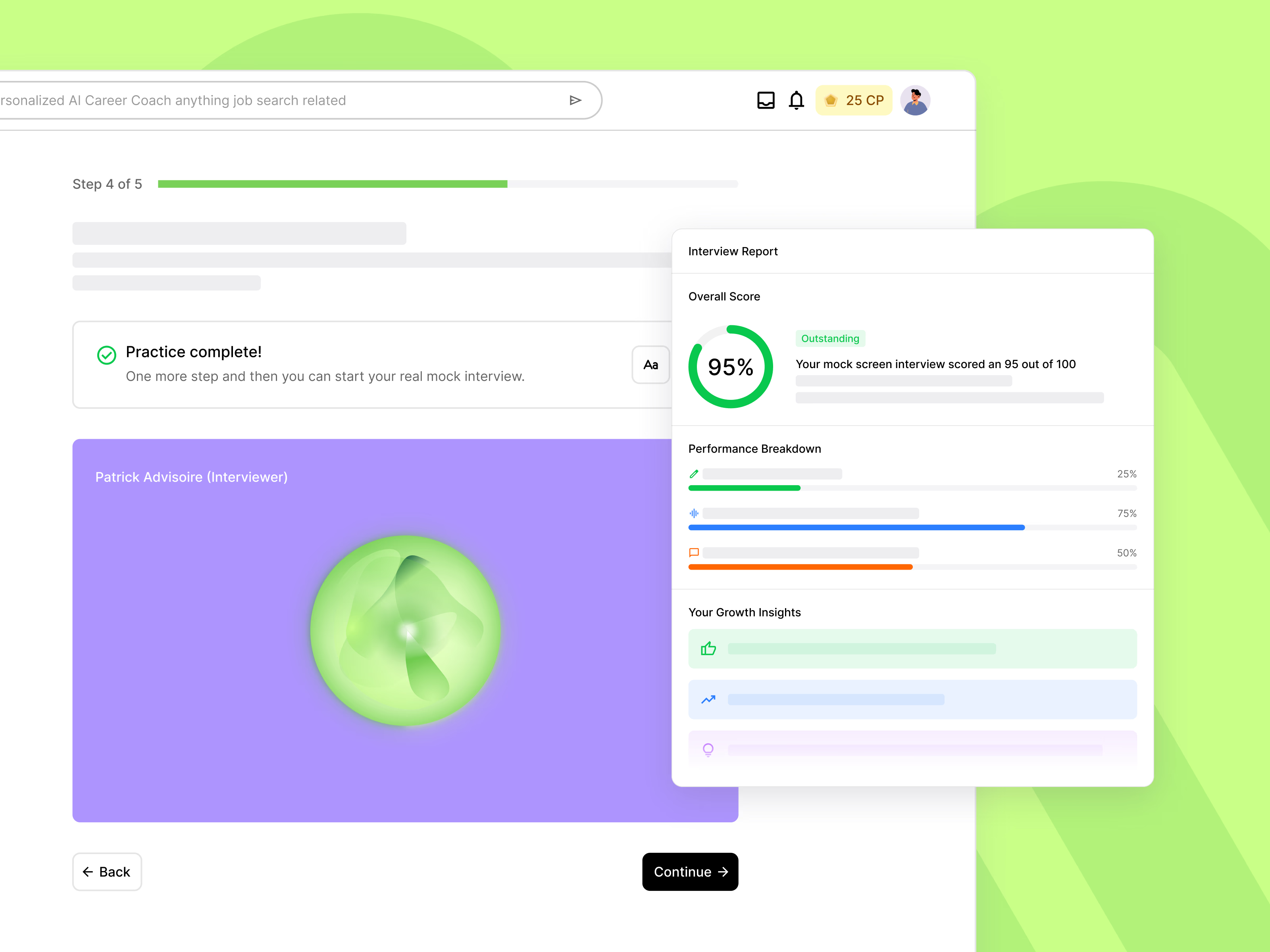
Prentus provides live, voice-based practice based on the job a student is pursuing. The interviewer asks follow-up questions, students can ask questions back, and each session produces feedback and a recording that advisors can review. It is part of a broader institutional career platform, so interview practice can sit alongside resume support, job tracking, advising, and outcome tracking.
Feedback and workflow
Scored reports, recordings, and advisor review
Confirm during evaluation
The broader platform scope may be more than a career center needs if it is procuring only a standalone interview library.
#2 Best for structured interview curriculum and dedicated practice
Big Interview
Big Interview is a dedicated interview-training platform that combines mock interview practice with structured learning content. Its focused scope makes it a practical shortlist candidate for institutions that want an established interview-preparation resource without replacing the rest of their career technology stack.
Feedback and workflow
AI-supported feedback across interview delivery signals
Confirm during evaluation
Career advising, job search, and employment outcome workflows remain outside the core interview-training scope.
#3 Best for connecting resume review with interview practice
Quinncia
Quinncia connects AI resume review with mock interviews. Its interview questions can draw on the student resume, which gives career teams a coherent preparation path from written experience to spoken answers. It is a focused option for institutions that already have separate systems for advising, jobs, and outcomes.
Feedback and workflow
Feedback on speech and visual delivery signals
Confirm during evaluation
Its core value is the resume and interview pairing, not a full career services platform.
#4 Best for institutions prioritizing resume scoring with interview practice
VMock
VMock is best known for AI resume feedback and also offers mock interview practice across career tracks. It belongs on the shortlist when a university wants resume preparation to lead the procurement and interview practice to extend the same student-readiness program.
Feedback and workflow
Interview analysis alongside benchmarked resume feedback
Confirm during evaluation
Institutions seeking a conversational interviewer or broader advising and outcome workflows should test those requirements directly during evaluation.
Institutional procurement checklist
The demo is the easy part. The durable decision comes from validating how the platform behaves under institutional requirements.
Security and privacy
- ✓ Data collected from students
- ✓ Audio and video retention
- ✓ Encryption and access controls
- ✓ Model-training policy
- ✓ Deletion, subprocessors, and incident response
Accessibility
- ✓ Current VPAT or conformance report
- ✓ Keyboard and screen-reader testing
- ✓ Captions or transcripts
- ✓ Voice and video alternatives
- ✓ Accommodation workflow and response times
Integrations and data
- ✓ SSO and account provisioning
- ✓ SIS, LMS, and career-platform fit
- ✓ Advisor roles and permissions
- ✓ Student-level and aggregate exports
- ✓ API availability and data ownership
Implementation
- ✓ Named implementation owner
- ✓ Pilot and rollout timeline
- ✓ Faculty and advisor enablement
- ✓ Student communication plan
- ✓ Support service levels and success review
How to run a fair pilot
- Select two or three real roles that reflect your institution's student population.
- Ask the same group of students to complete a first attempt, review feedback, and retry.
- Include students who use assistive technology and ask disability services to review the workflow.
- Have advisors evaluate whether reports identify students who need human support.
- Measure activation, completion, repeat practice, support burden, and advisor usefulness.
For a deeper product view, explore Prentus AI mock interviews, AI interview feedback, and the AI resume builder. Career leaders can also review how the platform supports online universities with student support at scale.
Frequently asked questions
What is an AI mock interview platform for universities?
An AI mock interview platform gives students on-demand spoken or recorded interview practice and automated feedback. Institutional products also give career teams administration, participation data, and controls that consumer interview tools may not provide.
How should a university compare AI mock interview platforms?
Use the same job scenarios and scoring rubric in every demo. Compare conversational realism, job-specific questions, feedback quality, advisor visibility, accessibility documentation, security review materials, authentication options, analytics, implementation support, and total contract scope.
Can AI mock interviews replace career advisors?
No. AI practice is best used for repeatable preparation that students can complete on demand. Advisors still provide context, encouragement, accommodations, nuanced coaching, and human judgment. A strong workflow lets advisors review progress and focus their time where it matters most.
What security questions should procurement ask?
Ask what data is collected, whether audio or video is retained, where data is stored, how it is encrypted, who can access recordings, whether student data trains models, how deletion works, what subprocessors are used, and which independent security documentation is available for review.
What accessibility requirements matter for AI interview practice?
Request a current VPAT or equivalent accessibility conformance report and test keyboard navigation, captions or transcripts, screen-reader behavior, color contrast, extended response time, and alternatives to voice or video. Include disability services and real student users in the evaluation.
How long should an institutional pilot run?
A useful pilot should cover at least one real recruiting cycle or course assignment. Define the participating programs, baseline participation, completion target, advisor workflow, accessibility testing, support process, and success measures before launch so the result can inform procurement.
Evaluate Prentus
See the student and advisor experience together
Bring your requirements and a real student use case. We'll show how voice-based practice, feedback, analytics, and career workflows fit your institution.
Book an institutional demo