

OBBBA Compliance for Higher Education
The Do No Harm earnings standard is law now, and the rule that implements it takes effect July 1, 2027. Programs that cannot prove graduates out-earn a high school diploma holder lose federal Direct Loan eligibility.
5 questions · 3 minutes · Know where you stand
Quick answer
What does the new federal earnings accountability law require?
It requires programs to prove graduates out-earn a benchmark worker. The law signed July 4, 2025 created the Do No Harm earnings standard, and the Department of Education implemented it through the STATS final rule, effective July 1, 2027. Miss the threshold in two of any three award years and the program loses federal Direct Loan eligibility.
Last updated August 11, 2026. Sourced to the STATS final rule, 91 FR 40136. Start with the STATS and Do No Harm explainer, then how gainful employment differs and Workforce Pell.
What Is the OBBBA Do No Harm Standard?
The law signed July 4, 2025 introduced the Do No Harm earnings accountability standard for Title IV institutions. Under it, programs must show that median graduate earnings exceed the median for working adults aged 25 to 34 with only a high school diploma in the institution's state, measured four years after completion. Graduate programs are measured against working adults aged 25 to 34 holding only a baccalaureate degree.
Failure in two of any three consecutive award years costs federal Direct Loan eligibility. The standard reaches public, nonprofit, and for-profit institutions alike, across more than 200,000 programs that enroll Title IV students nationally. The statutory earnings test covers degree programs and graduate non-degree programs, while undergraduate certificate programs sit under the separate gainful employment rule until the two are harmonized.
One clarification that matters. Do No Harm and STATS are not two separate rules. They come from the same law and the same rulemaking. The Department of Education's STATS final rule, published July 1, 2026 and effective July 1, 2027, is how Do No Harm gets implemented, and it folds gainful employment and Financial Value Transparency in at the same time. See the STATS and Do No Harm explainer for the earnings test mechanics, and our report on the first-destination data gap for why survey-based outcome data cannot carry this.
What Changed
What the OBBBA Changed
Signed into law July 4, 2025, three accountability requirements your institution needs to understand now
"Do No Harm" Earnings Test
All degree programs must prove graduates earn more than someone with only a high school diploma. Fail two of three consecutive years and your program loses federal loan eligibility.
Workforce Pell Requires 70% Placement
Short-term programs of at least 8 and fewer than 15 weeks became Pell-eligible in July 2026, but only with a verified 70% completion rate and a 70% job placement rate measured in the second quarter after program exit.
Learn more →
Gainful Employment Active Until STATS
Gainful employment remains in effect for certificate programs everywhere and all programs at for-profit institutions. Covered programs answer to both frameworks today, and STATS absorbs them into one earnings premium test on July 1, 2027.
Learn more →
The Accreditation Angle
More Than Compliance, an Accreditation Risk
Your accreditor
Will review outcome data at renewal. "We're working on it" isn't an answer when the earnings test is already measuring your programs.
Your board
Will ask how graduate earnings compare to the state benchmark. This makes program-level outcome data part of every board conversation.
Your prospective students
Will compare programs by outcome data before they enroll. Enrollment follows outcomes, and these comparisons are about to be far more visible.
Your at-risk programs
Get one year of mandatory student warnings. Then failure in two of any three consecutive award years means no federal Direct Loans for that program.
Know Where You Stand Right Now
5 questions. 3 minutes. Find out if your institution tracks outcomes the way OBBBA requires.
Take the Free Readiness AssessmentGet a Free Outcomes Diagnosis
Bring your graduate placement and earnings numbers. We look at where career support can fit into the programs, orientation, and advising you already run, then hand you a gap plan for the STATS transition. 30 minutes, no sales pitch.
Get a Free Outcomes DiagnosisThe Prentus Approach
Automated Outcome Tracking, Always Audit-Ready
Career services teams can't run annual survey campaigns for 20,000 students and also do their jobs. Prentus automates the tracking so data is always current.
LinkedIn Auto-Detection
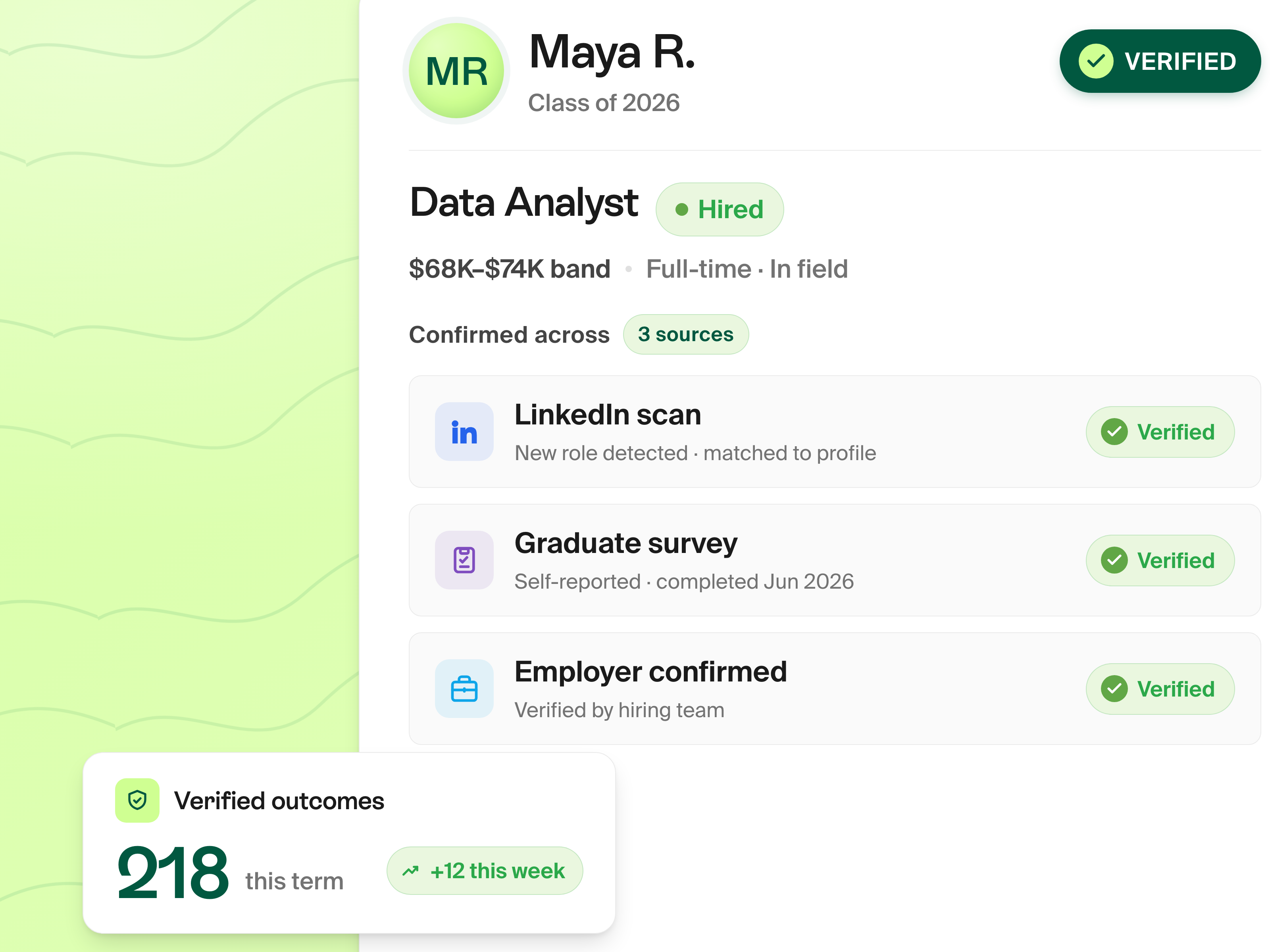
Prentus automatically scans LinkedIn to verify employment status and employer name. No survey needed. Your outcome data updates continuously.
Program-Level Reporting
Export outcome data by program, credential level, and cohort. Exactly the format DoE's earnings test requires. Board-ready in minutes.
180-Day Placement Tracking
For Workforce Pell programs, Prentus tracks the 180-day post-completion window automatically, meeting the 70% placement rate requirement.
Multi-Program Dashboard
See outcome rates across every program at a glance. Flag programs approaching the Do No Harm threshold before your DoE report does.
The Old Way vs the Prentus Way
✗ Without Prentus
- ✗Annual survey campaigns to 20,000 students with 20% response rates
- ✗Staff manually compiling data from 6 different systems before every review
- ✗Outcome reports that take 3 months to produce
- ✗No visibility into at-risk programs until DoE tells you
- ✗Board meetings with estimates instead of verified data
- ✗No process for students who don't respond
 With Prentus
- ✓LinkedIn auto-detection runs continuously, no survey campaigns needed
- ✓Outcome data compiles automatically by program and cohort
- ✓Board-ready reports in minutes, not months
- ✓Dashboard flags programs approaching the Do No Harm threshold
- ✓Verified earnings data, not estimates
- ✓Non-responder tracking with documented follow-up attempts
Free Resource
OBBBA Compliance Checklist
10 requirements your institution must be able to answer with data, not estimates.
Graduate Outcome Definitions
You have a written, program-level definition of a successful outcome, not just any job, but one that clears the earnings threshold relevant to your credential level.
Earnings Tracking by Program
You track graduate earnings at the program level, not just institution-wide. A student working in a different field than their program shouldn't inflate your numbers.
Four-Year Post-Completion Measurement
The earnings premium measures completers four years after they finish. Your tracking has to reach well past the six-month survey window to see the cohort that will be graded.
State-Level Earnings Comparison Data
You can compare your graduates' median earnings to the state median for working adults aged 25 to 34 with only a high school diploma, or only a baccalaureate degree for graduate programs. When fewer than 50% of enrolled students come from your state, the national threshold applies instead.
Automated Reporting Infrastructure
Your outcome data compiles automatically, not through staff manually exporting from five different systems before an accreditor visit.
Multiple Verification Methods
You don't rely solely on student self-reporting. LinkedIn verification, employer records, or third-party wage data back up your employment numbers.
Non-Responder Documentation
You have a documented process for students who don't respond to employment follow-ups, with final status codes and attempt records.
Cohort Tracking
You track the same cohort of students over time, not a moving population. This is how DoE calculates the earnings test.
Year-One Failure Warning Process
Institutions must warn enrolled students that a program will lose Direct Loan eligibility once it has failed the measure for one year. You have that process ready.
Board-Ready Outcome Reports
You can produce a program-level outcome report within 30 days of request, not a scramble to pull data three months before a board meeting.
Get the Full Checklist + Documentation Guide
Printable PDF with all 10 items, checkboxes, documentation space, and notes on what DoE actually looks for.
No spam. We'll send the PDF and add you to our OBBBA update list.
“Prentus uniquely understands that career services is an enrollment and retention lever, not just a graduation requirement.”Ana Aristizabal, Director of Investments, Potencia Ventures
How to Prepare for OBBBA Earnings Accountability
Readiness has to be in place before the first reporting cycle, and the steps depend on each other, so order matters. Program leadership goes first: define what counts as a successful outcome at the program level, not institution-wide, since a blended institutional number hides the programs closest to the Do No Harm threshold.
Institutional research or career services goes second: stand up earnings and employment tracking that reaches four years past completion, because that is the cohort the Department actually measures, well past the six-month window most survey programs stop at.
Third, the registrar or IR office maps every program to its correct comparison group, state or national threshold and undergraduate or graduate credential level, so the earnings test runs against the right benchmark. Fourth, career services documents a non-responder process with final status codes, so gaps in self-reported data do not stall a report or get challenged later.
Last, whoever owns compliance reporting, typically IR or the provost's office, builds a standing pipeline that compiles this data automatically rather than reconstructing it from five systems before every board meeting or accreditor visit. Each owner depends on the outcome definitions and comparison groups the earlier steps set, which is why sequence matters as much as the individual pieces.
Common Questions
OBBBA Compliance FAQ
Does Do No Harm apply to my institution if we are a nonprofit?
Yes. The Do No Harm earnings standard applies to Title IV institutions across public, nonprofit, and for-profit sectors. The statutory earnings test covers degree programs and graduate non-degree programs, while undergraduate certificate programs sit under the gainful employment rule until the STATS final rule harmonizes them on July 1, 2027. Once STATS takes effect, nearly every Title IV program is in scope regardless of tax status or credential level.
Do we have to report earnings data ourselves?
No. The Department of Education calculates earnings thresholds using Census Bureau data and provides results to institutions annually. What you need is a reliable record of which graduates are employed and in what roles, so you can verify and appeal DoE's data if needed.
Can a program lose Pell Grant eligibility if it fails the earnings test?
After one failing year, the institution must warn enrolled students that the program will lose Direct Loan eligibility. After failure in two of any three consecutive award years, the program becomes a low-earning outcome program and cannot disburse Direct Loans, for at least two years and indefinitely until the institution requalifies it. Pell Grant eligibility is separate. A program loses Pell only where the institution fails the new administrative capability standard at 34 CFR 668.16(t), which requires that at least half of Title IV recipients and at least half of Title IV dollars sit outside low-earning outcome programs.
How is gainful employment different from Do No Harm?
They cover different programs with different tests and different penalties. Gainful employment applies to non-degree certificate programs at all institutions plus all programs at for-profit institutions, and it uses both an earnings test and a debt-to-earnings ratio. Do No Harm covers degree programs and graduate non-degree programs and uses an earnings comparison only. Covered programs answer to both today. The side-by-side table is on the gainful employment page.
Are OBBBA, Do No Harm, and STATS three separate requirements?
No. They are one law and one rulemaking. The law signed July 4, 2025 created the Do No Harm earnings standard, and the Student Tuition and Transparency System final rule, published July 1, 2026 at Docket ID ED-2026-OPE-0100 and effective July 1, 2027, is the regulation the Department wrote to carry it out. That same rule harmonizes gainful employment and Financial Value Transparency into the earnings premium test. There is no separate STATS Act and no second deadline for a second rule.
How should a college prepare for OBBBA earnings accountability?
Preparation has to be in place before the first reporting cycle, in this order. First, program leadership defines what counts as a successful outcome at the program level, not institution-wide. Second, institutional research or career services stands up earnings and employment tracking that reaches four years past completion, since that is when the Department measures the cohort. Third, the registrar or IR office maps every program to its correct comparison group, state or national, and credential level. Fourth, career services documents a non-responder process so gaps in self-reported data do not stall a report. Fifth, whoever owns compliance reporting, usually IR or the provost's office, builds a standing pipeline that compiles this data automatically rather than reconstructing it each cycle. Each step has a clear campus owner: program leadership, IR, the registrar, career services, and compliance, in that order, because later steps depend on the outcome definitions and comparison groups the earlier ones set.
Get a Free Outcomes Diagnosis
Bring your graduate earnings numbers to a 30-minute working session. We map where career support can be integrated into the programs, orientation, and advising you already run, then hand you a gap plan for the STATS transition. No sales pitch.
Book 30-Minute DemoOr take the free readiness assessment, see Gainful Employment requirements, or read the STATS and Do No Harm explainer, or our report on the first-destination data gap. For compliance updates in your inbox weekly, subscribe to the Weekly Workforce Wire.