Quick Summary
An informational interview is a lower-stakes conversation a student initiates with a professional in their target field to learn about an industry, role, or career path, not to apply for a specific job. Unlike formal job interviews, the pressure to perform is lower, but the opportunity to make a real professional impression is just as real. According to research from the National Association of Colleges and Employers (NACE), verbal self-presentation ranks among the top three skill gaps career advisors observe in students entering the job market, yet it's rarely addressed with structured, repeated practice. Prentus AI mock interviews give institutions a way to provide that practice at scale, so every student, not just the ones who self-advise, gets fluent in talking about who they are and what they bring.
Ask a student to tell you about their background. Watch what happens. Many will start strong, then trail off. Others will apologize for not having enough experience. A surprising number will simply freeze. This isn't a confidence problem. It's a preparation problem, and most career services programs are solving it backwards.
Why do students struggle in job interviews?
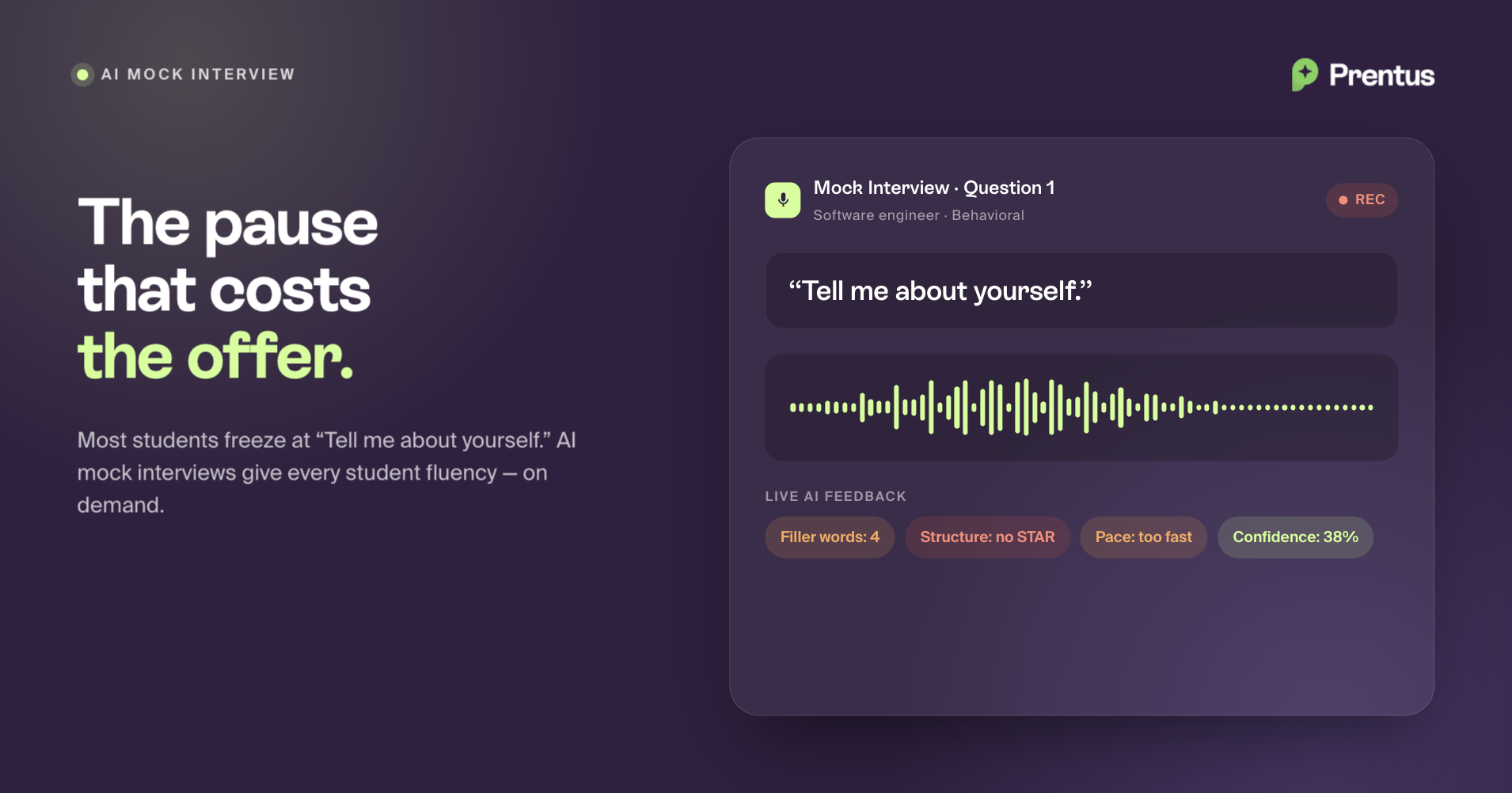
Students struggle in job interviews primarily because they lack practice articulating their experiences, skills, and value. Most career services programs focus on resume writing and job board access rather than structured interview preparation. The result is that students who have relevant skills and knowledge cannot communicate them under pressure. AI mock interview tools address this gap by providing unlimited, on-demand practice sessions with real-time feedback, building the verbal fluency that only comes from repetition.
The Real Gap in Career Readiness
Career services teams spend significant time helping students with resumes, LinkedIn profiles, and job search strategies. But there's a foundational skill that gets treated as optional: the ability to talk about yourself fluently, clearly, and with confidence.
When we say students freeze in interviews, we don't mean they're shy. We mean they've never been in a position where they had to practice speaking about themselves out loud, under pressure, with someone actually listening. They've written about their experience a dozen times. They've never said it out loud until it mattered.
The result is predictable. Students walk into informational interviews, coffee chats with recruiters, and first-round interviews underprepared, not because they lack experience, but because they've never been asked to articulate that experience out loud.
A 2025 survey from the National Association of Colleges and Employers found that career advisors ranked "verbal self-presentation" as one of the top three areas where students need the most improvement, yet it remains one of the least addressed in standard programming. That gap has consequences.
What Recruiters Say Students Get Wrong
Recruiters and hiring experts consistently flag the same patterns when students stumble in interviews. These aren't advanced skills. They're fundamentals:
- Answering "Tell me about yourself" with a vague or rambling response instead of a structured 60-second narrative
- Using the STAR method (Situation, Task, Action, Result) inconsistently or not at all for behavioral questions
- Speaking too fast when nervous, relying on filler words like "um," "uh," and "like"
- Failing to translate classroom projects, part-time work, and extracurriculars into relevant professional experience
- Not having thoughtful questions prepared for the interviewer
Research from Boise State Career Services notes that "practice feeling prepared" is one of the most underused strategies among students, yet it's the single highest-leverage thing a student can do before an interview. The pattern is clear: students know what good looks like, they just haven't done enough of it.
Why Mock Interviews Rarely Happen at Scale
Here's the uncomfortable truth about mock interviews: most students never do them. Not once.
The standard model depends on a trained professional sitting across from a student for 30 to 60 minutes. Career advisors are stretched across 1:400 to 1:600 student ratios. Alumni volunteers are generous but inconsistent. Peer practice lacks the structure to deliver useful feedback.
The result: most mock interview programs serve a small fraction of the student body, typically seniors who are already on track, or students who self-identify as struggling. The students who need the most help are often the least likely to seek it out.
Northeastern University's Silicon Valley campus ran a three-day Interview Skills Bootcamp in early 2026 that touched on storytelling frameworks, elevator pitches, and paired mock interview sessions. The value they identified wasn't in the content. It was in the practice. Students who did the work "learned a vocabulary for talking about themselves with clarity and confidence," wrote one facilitator. That's the insight that matters.
The problem isn't that students don't know what to say. It's that they've never had to say it out loud until the stakes were real.
Why Informational Interviews Are the Right Starting Point
When career services thinks about mock interviews, the instinct is to simulate the formal job interview: the one with the panel, the case study, the formal evaluation. That's useful for seniors. But it's the wrong place to start building the skill.
Informational interviews are lower-stakes, more frequent, and happen earlier in a student's career timeline. A first-year student having coffee with a professional in their intended field is already doing career-facing work. But without practice, that conversation often goes nowhere: the student asks a few surface questions, thanks the professional, and leaves without having made a real connection or demonstrated their potential.
The ability to lead a good informational conversation is the same ability required to excel in a formal interview: structured self-presentation, thoughtful follow-up questions, the ability to articulate your interests and goals without rambling or underselling yourself. The difference is that informational interviews give students room to practice without the pressure of being evaluated for a job.
Making AI mock interview practice the default activity for students before their first informational conversation doesn't just improve their interviewing. It makes every conversation they have more valuable, for them and for the professional they're connecting with.
What AI Makes Possible
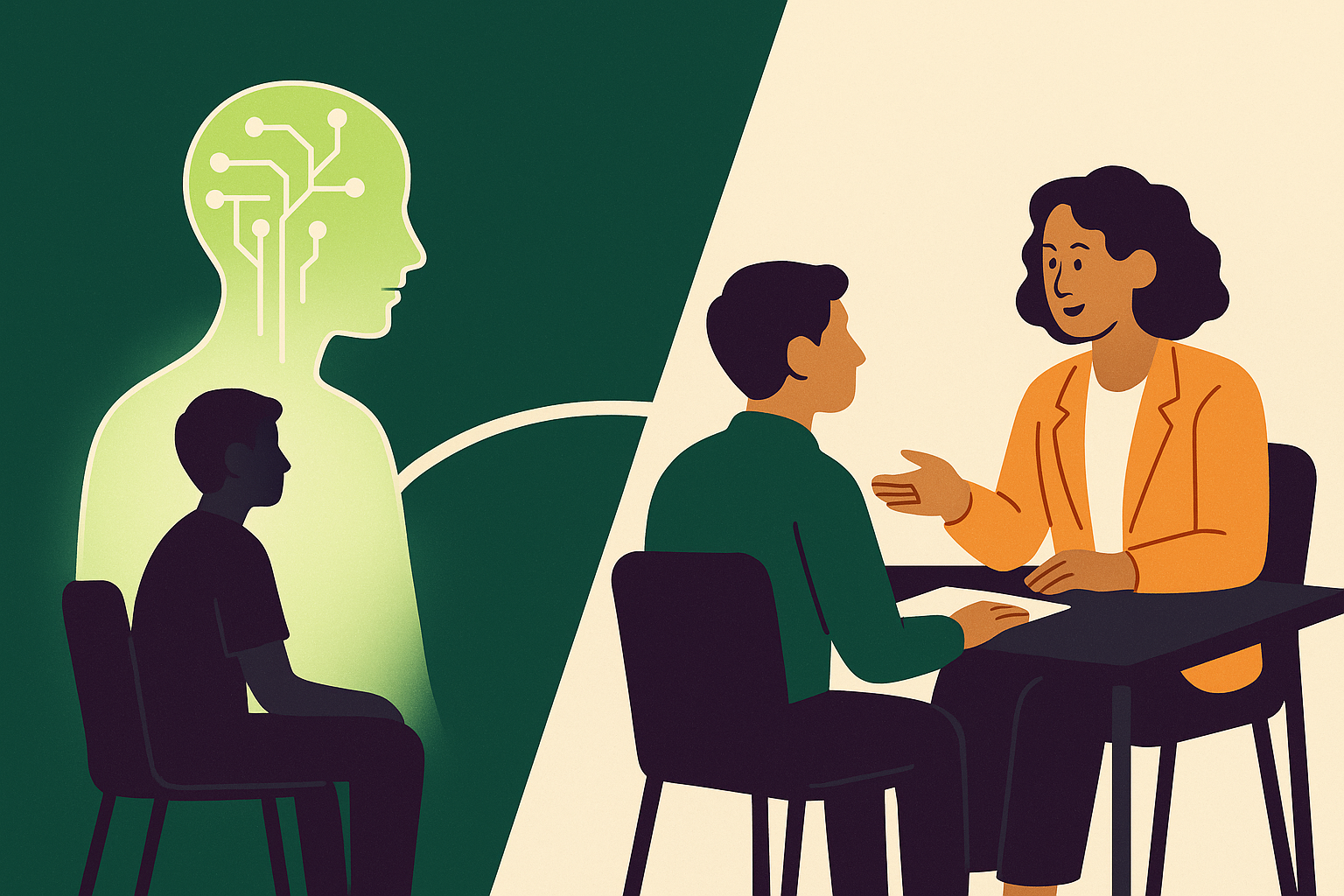
The core constraint with mock interviews has always been human time. Prentus removes that constraint.
With AI mock interviews, any student can run a full practice session on their own schedule: Sunday night at 11pm, the morning before a networking event, five times in a row the week before an interview. There's no scheduling friction. No advisor required. No awkwardness with a peer who's also learning.
The AI asks role-specific questions, follows up naturally based on student responses, and delivers immediate feedback on:
- Whether answers directly addressed the question asked
- The use of structure (STAR or equivalent frameworks)
- Communication patterns: filler words, pacing, and confidence in delivery
- Specific, actionable suggestions for improvement
Students who practice this way come to their next career services appointment already warmed up. They arrive with specific questions about strategy, not generic anxiety about the process. Advisors can spend their limited time on the work that actually requires a human: relationship building, complex career decisions, employer engagement.
How to Make This Part of Your Standard Practice
Here's the practical part. The goal isn't to add one more thing to your programming calendar. The goal is to make interview practice so accessible that it stops being optional.
Build it into the classroom.
Make AI mock interview practice part of the standard career readiness curriculum, not an optional workshop students sign up for voluntarily. Embed it into coursework, first-year programs, or capstone prep so every student gets exposed to structured interview practice before they need it in the real world. This is logistics, not innovation.
Connect practice to real touchpoints.
If a student has an upcoming coffee chat, employer visit, or networking event, have them do a focused mock interview session beforehand. The practice becomes purposeful, and more memorable.
Give students a specific benchmark for "ready."
The goal isn't perfection. It's fluency. A student who can walk a career advisor through their background in 90 seconds, answer two behavioral questions using concrete examples, and ask three thoughtful questions about a target company is ready. That's the standard.
The Bottom Line
The students who need the most help are the least likely to seek it out voluntarily. That's not a motivation problem. It's a design problem.
When mock interviews require scheduling a human appointment, you're building a barrier that filters out exactly the students who most need the practice. When it's available on demand, with immediate feedback, with no human in the room to impress or disappoint, the access problem disappears.
Students aren't going to get better at talking about themselves by reading about it. They need to do it. They need to do it often. And they need to start before the stakes are so high that mistakes feel catastrophic.
AI mock interviews make that possible at the scale the problem actually requires.
If you're ready to explore how AI practice can become a core part of your career readiness model, we'd welcome the conversation.