

Gainful Employment and Do No Harm, Side by Side
Covered programs answer to both tests in 2026, with different scope and different penalties. The STATS final rule folds them into one earnings premium test on July 1, 2027.
Quick answer
How is gainful employment different from Do No Harm?
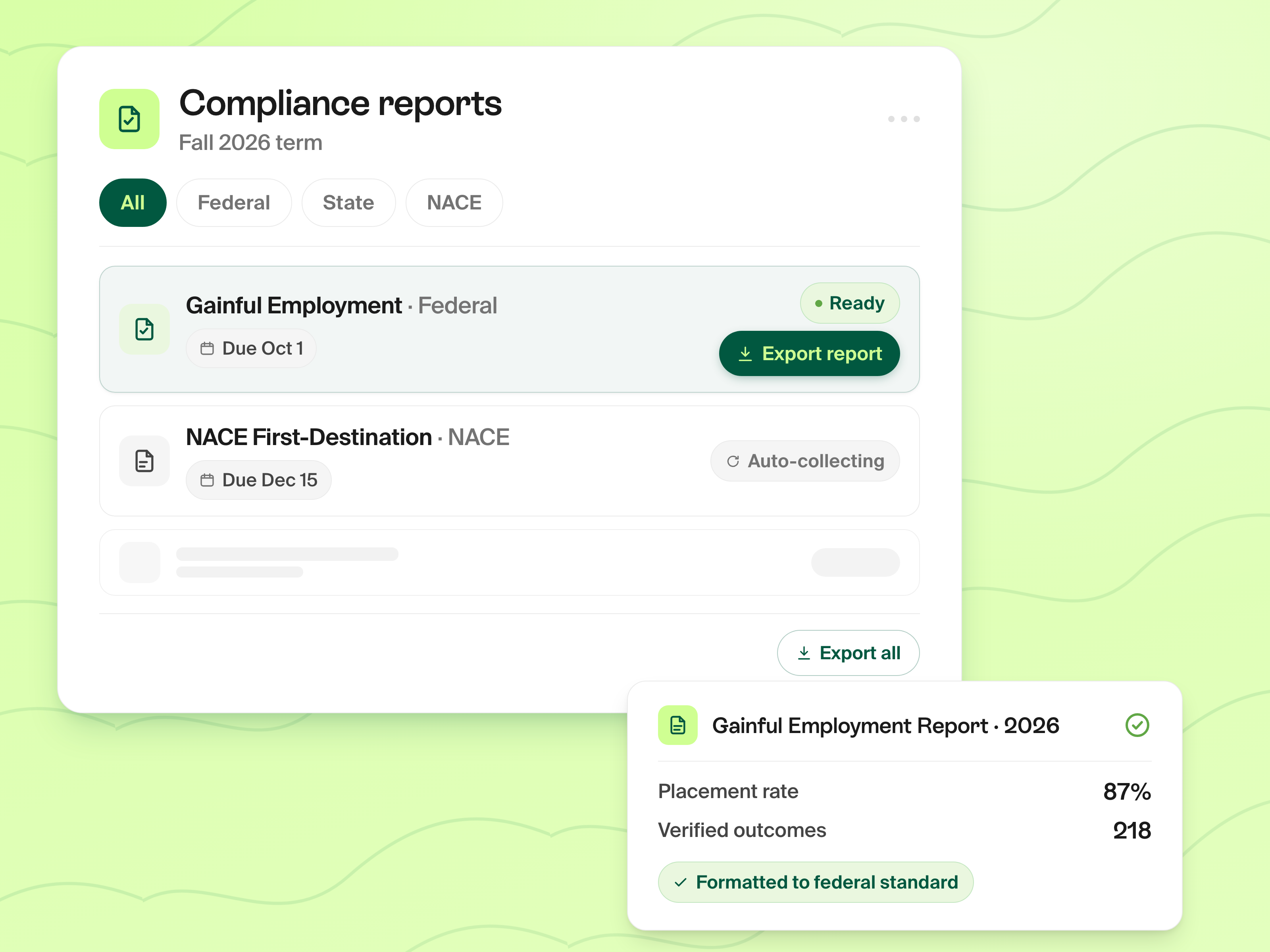
Gainful employment covers certificate programs everywhere plus all programs at for-profit institutions, and applies a debt-to-earnings test alongside an earnings test. Do No Harm is the newer earnings comparison, and failing it costs Direct Loans. The STATS final rule merges both into one earnings premium test on July 1, 2027 and drops debt-to-earnings.
Last updated August 11, 2026. Sourced to the STATS final rule, 91 FR 40136, published July 1, 2026.
The Comparison
How these three rules actually differ
Two frameworks apply in 2026 and one replaces them both in 2027. Mixing them up is the most common mistake in the market right now, so here they are in one table.
| Gainful employment | Do No Harm earnings standard | STATS earnings premium | |
|---|---|---|---|
| What it is | A long-standing regulation requiring covered programs to show graduates can repay what they borrowed | The earnings accountability standard created by the law signed July 4, 2025 | The single framework the Department of Education built to replace both |
| Legal source | Existing Title IV regulation, reported through the Financial Value Transparency framework | Statute, with a statutory effective date of July 1, 2026 | Final rule at 91 FR 40136, Docket ID ED-2026-OPE-0100, RIN 1840-AE06, published July 1, 2026 |
| Programs covered | Non-degree certificate programs at every institution, plus all programs at for-profit institutions | Degree programs and graduate non-degree programs, at every institution regardless of tax status | Nearly every Title IV program, at any credential level and any tax status. The old carve-outs are gone |
| Tests applied | An earnings test and a debt-to-earnings ratio test | An earnings comparison only | One earnings premium measure. Debt-to-earnings is rescinded |
| The benchmark | Annual loan payments measured against graduate earnings | A typical high school diploma holder for undergraduate programs, a typical bachelor's holder for graduate programs | Median earnings of working adults aged 25 to 34 with only a high school diploma, or with only a baccalaureate degree for graduate programs, from Census Bureau data |
| What failure costs | Failure in two of three consecutive years puts all Title IV eligibility at risk, including Pell Grants | Loss of Direct Loan eligibility | Two of any three consecutive award years below the threshold makes a program a low-earning outcome program and ends Direct Loan disbursement, for at least two years. Pell is only at risk through the institution-level administrative capability standard at 34 CFR 668.16(t) |
| Appeals | Available under the existing gainful employment process | Set by the implementing regulation | Within 30 days of the notice, and only on calculation error. The completer list, the threshold applied, and the earnings comparison are the three permitted grounds |
| Status right now | In force. One final legacy reporting cycle is due October 1, 2026 for the 2025 to 2026 award year | In force as statute, implemented through the STATS rulemaking rather than a separate one | Effective July 1, 2027, with amendatory instructions 13 and 14 effective August 31, 2026 |
One thing worth naming plainly. Do No Harm and STATS are not two separate requirements from two separate laws. They come from the same statute and the same rulemaking, which is why the Department could fold gainful employment into them rather than run a third track. If a summary presents them as two rules with two deadlines, it is wrong. The full mechanics are in the STATS and Do No Harm explainer.
Where gainful employment stands in 2026
Gainful employment still applies. It covers non-degree certificate programs at every institution and all programs at for-profit institutions, and it pairs an earnings test with a debt-to-earnings ratio test. A program failing in two of three consecutive years puts its Title IV eligibility at risk, Pell Grants included, which is a harder consequence than the loan-only penalty attached to the new earnings standard.
The Do No Harm earnings standard was layered on top rather than swapped in, so covered programs answer to both this year. That double surface is temporary by design. The Department of Education's STATS final rule, published July 1, 2026, harmonizes gainful employment, Financial Value Transparency, and the statutory earnings accountability framework into one earnings premium test, effective July 1, 2027.
Two near-term dates matter. One final legacy gainful employment and Financial Value Transparency reporting cycle is due October 1, 2026, covering the 2025 to 2026 award year. Then on July 1, 2027 the debt-to-earnings metric disappears and the earnings premium becomes the only earnings accountability measure. The Department estimated that dropping debt-to-earnings moves the share of failing programs from 5.3 percent to 5.2 percent, roughly 100 programs out of the more than 200,000 that enroll Title IV students nationally, so the simplification does not soften the standard.
For every rule change and reporting deadline as it lands, browse the Weekly Workforce Wire archive.
Not sure what tighter compliance and reporting is worth to your team? Use the career services ROI calculator to see the time and cost impact for your institution.
“The most interconnected, well-integrated tools that do the hard work but keep our advising team at the center.”Richard Korczyk, Chief Experience Officer
What Both Frameworks Require
The data both frameworks run on
Graduate Earnings by Program
Both frameworks turn on program-level earnings. The Department pulls the earnings side from IRS data and the thresholds from the Census Bureau, so your own verified figures are how you sanity-check the result before a determination lands.
Loan Debt by Program
The gainful employment debt-to-earnings test compares median loan payments to median earnings, so you need to know what students in each program borrowed. That requirement disappears on July 1, 2027 when the metric is rescinded, and until then it is still live.
Completion Rates by Cohort
Financial Value Transparency (FVT) reporting, required under GE, includes completion rates by program. The final legacy FVT and GE reporting cycle opens July 1, 2026, and is due October 1, 2026, before STATS takes over.
Employment Verification
Both rules benefit from independent employment verification, not just student surveys. LinkedIn detection and employer records give you defensible data if you need to appeal DoE calculations.
A Tracking Window That Outlasts Graduation
The earnings premium measures completers four years after they finish, from data reported to the IRS. A tracking process that ends with a six-month survey cannot see the cohort that will actually be graded.
Audit-Ready Program Reports
Both frameworks come with an appeals process. When DoE calculates your rates, you need your own clean data to review, verify, and appeal if needed. Spreadsheets won't hold up.
Get a Free Outcomes Diagnosis
Bring your placement and earnings numbers. We look at where career support can fit into the programs, orientation, and advising you already run, then hand you a gap plan for the STATS transition. 30 minutes, no sales pitch.
Get a Free Outcomes DiagnosisThe Old Way vs the Prentus Way
✗ Without Prentus
- ✗Separate manual tracking processes for GE and Do No Harm
- ✗Survey campaigns for earnings verification that students ignore
- ✗No visibility into debt-to-earnings ratios until DoE publishes results
- ✗Appeals process requires scrambling to find data you didn't keep
- ✗FVT reporting compiled from multiple disconnected systems
- ✗At-risk programs discovered after the fact, not before
 With Prentus
- ✓One platform tracks outcomes for both GE and Do No Harm requirements
- ✓Automatic LinkedIn scan plus dozens of third-party sources verify employment, with built-in surveys filling any gaps
- ✓Earnings and debt data surfaced by program, ready to review before DoE reports
- ✓Clean audit trail ready for any GE or Do No Harm appeals
- ✓FVT-ready reporting exports automatically
- ✓At-risk programs flagged proactively, with time to intervene before a failing year
Free Sample
See which graduates you can already verify
Free scan, results in about 30 seconds.
Run a Free Outcomes ScanCommon Questions
Gainful Employment and Do No Harm FAQ
How is gainful employment different from Do No Harm?
They are different frameworks with different scope, tests, and penalties. Gainful employment covers non-degree certificate programs at every institution plus all programs at for-profit institutions, and applies both an earnings test and a debt-to-earnings ratio test. Do No Harm is the earnings accountability standard created by the law signed July 4, 2025, it applies an earnings comparison only, and failure costs Direct Loan eligibility. The Department has merged both into a single earnings premium test through the STATS final rule, effective July 1, 2027, which also rescinds debt-to-earnings entirely.
What is the gainful employment rule?
It requires covered programs to show that graduates can repay what they borrowed, using a debt-to-earnings ratio alongside an earnings test, with reporting handled through the Financial Value Transparency framework. It covers non-degree certificate programs at all institutions and all programs at for-profit institutions. Programs failing in two of three consecutive years lose Title IV eligibility. The rule stays in force until STATS takes effect on July 1, 2027.
Does the gainful employment rule still apply in 2026?
Yes. The new earnings accountability standard was layered on top rather than swapped in, so covered programs answer to both this year. That ends July 1, 2027. Before then, institutions owe one final legacy gainful employment and Financial Value Transparency reporting cycle, due October 1, 2026 for the 2025 to 2026 award year, which is the most urgent date on this page.
Does STATS eliminate the debt-to-earnings ratio?
Yes. The final rule rescinds the debt-to-earnings rates metric and adopts the earnings premium as the sole earnings accountability metric. The Department reasoned that the statute establishes an earnings comparison only, and that keeping debt-to-earnings would move the share of failing programs from 5.2 percent to 5.3 percent, roughly 100 additional programs out of the more than 200,000 that enroll Title IV students nationally.
Which is stricter, gainful employment or Do No Harm?
Through July 1, 2027, gainful employment is the harder standard for covered programs, because it applies two tests instead of one and a failure puts all Title IV eligibility at risk rather than loans alone. After STATS takes effect the shape changes. One test applies, a failing program loses Direct Loans, and Pell is only at risk through the new institution-level administrative capability standard at 34 CFR 668.16(t).
Which programs are in scope once STATS takes effect?
Nearly every program eligible for Title IV federal student aid, without regard to institutional tax status or credential level. The narrow scope that let most degree programs at public and nonprofit institutions sit outside gainful employment is removed, and undergraduate certificate programs are harmonized with everything else. The same earnings premium standard then applies across for-profit institutions, community colleges, and four-year universities.
Sources
Every legal claim and figure in the comparison above traces to one of these. Last updated August 11, 2026.
- STATS final rule, 91 FR 40136, published July 1, 2026, effective July 1, 2027. Docket ID ED-2026-OPE-0100, RIN 1840-AE06
Source for the rescission of the debt-to-earnings metric, the scope expansion across credential levels and tax status, the consequence ladder, the 30-day calculation-error appeal, the administrative capability standard at 34 CFR 668.16(t), and the 5.2 versus 5.3 percent failure comparison.
- U.S. Department of Education announcement of the final rule, June 29, 2026
Source for the harmonization of the new earnings standard with the existing Financial Value Transparency and gainful employment regulations, and for the undergraduate and graduate benchmark framing.
- Association for Institutional Research, program accountability reporting
Source for the October 1, 2026 legacy Financial Value Transparency and gainful employment reporting deadline covering the 2025 to 2026 award year.
Get a Free Outcomes Diagnosis
Bring your placement and earnings numbers to a 30-minute working session. We map where career support can be integrated into the programs, orientation, and advising you already run, then hand you a gap plan for the STATS transition. No sales pitch.
Book 30-Minute DemoOr take the free OBBBA readiness assessment, learn about Workforce Pell requirements, see the STATS and Do No Harm explainer, or read the gainful employment compliance guide, or our report on the first-destination data gap. For compliance updates in your inbox weekly, subscribe to the Weekly Workforce Wire.