
Related reading: how to build a LinkedIn profile as a new grad, how to ace your next interview, and the best job application trackers.
You have spent years in classrooms, completed projects, maybe pulled a few all-nighters finishing your capstone. Now you are staring at a blank resume template and wondering how to fill it when your work history section is essentially empty. Here is the truth: every hiring manager knows new graduates. The Bureau of Labor Statistics tracks which occupations are growing fastest, helping you target your resume to high-demand fields do not have ten years of experience. What they are looking for is evidence that you can learn, contribute, and show up. Your resume just needs to prove that clearly.
What should a new graduate put on a resume?
New graduates should build their resume around relevant coursework, academic projects, certifications, volunteer work, and transferable skills rather than trying to fill a work experience section they do not have. Hiring managers evaluating entry-level candidates look for evidence of learning ability, initiative, and communication skills. A well-structured resume with strong action verbs, quantified project outcomes, and role-targeted keywords will outperform a generic template regardless of work history length.
Your Education Is Experience. Frame It That Way.
The biggest mistake new graduates make is treating their education section as a throwaway line: degree name, school name, graduation date. Done. But your education is the most substantial experience you have right now, and it deserves real estate on the page.
Start by listing relevant coursework, but be strategic about it. Do not list every class you took. Pick three to five courses that directly relate to the roles you are applying for. If you are going after a marketing position, list courses like Consumer Behavior, Digital Marketing Strategy, or Data Analytics rather than Intro to Sociology.
Academic projects are your secret weapon. That semester-long group project where you built a financial model, designed a mobile app prototype, or conducted original research? That is real work. Describe it the same way you would describe a job: what was the goal, what did you do, and what was the result.
Instead of “Completed group project for Marketing 301,” try “Led a 4-person team to develop a go-to-market strategy for a local nonprofit, resulting in a campaign framework the organization adopted for their spring fundraiser.”
Quantify Everything You Can
Numbers make vague accomplishments concrete. Recruiters scan resumes quickly, and quantified achievements stop them from scrolling. You do not need revenue figures or enterprise metrics to quantify your impact. Think about:
- Scale: How many people did you work with, lead, or serve? “Managed social media content for a student organization with 500+ members.”
- Frequency: How often did you do something? “Published 3 articles per week for the campus newspaper over 2 semesters.”
- Improvement: Did something get better because of your work? “Redesigned the club's event registration process, reducing check-in time from 15 minutes to 3 minutes.”
- Rankings or recognition: “Placed 2nd out of 40 teams in the university business case competition.”
If you genuinely cannot quantify something, use strong action verbs instead: spearheaded, designed, analyzed, coordinated, launched. But always try the number first.
ATS Optimization: Getting Past the Robots
Before a human ever reads your resume. NACE career readiness competencies align closely with what employers look for in entry-level candidates, it will likely pass through an Applicant Tracking System. Most large employers and a growing number of mid-size companies use ATS software to filter applications. If your resume is not ATS-friendly, it may never reach a recruiter's screen.
Here is what matters for ATS compatibility:
- Use standard section headings. “Experience,” “Education,” and “Skills” work better than creative alternatives like “My Journey” or “What I Bring.”
- Mirror the job posting language. If the posting says “project management,” use that exact phrase on your resume rather than “managing projects.” ATS systems often match on exact keywords.
- Stick to simple formatting. Avoid tables, text boxes, headers/footers, and multi-column layouts. Many ATS parsers struggle with these and will scramble your content.
- Save as PDF unless told otherwise. PDFs preserve formatting and are generally well-parsed by modern ATS systems. Only use .docx if the application specifically requests it.
Common Formatting Mistakes That Sink New Grad Resumes
Formatting matters more than most new graduates realize. A recruiter will spend roughly six to seven seconds on an initial resume scan. If they cannot find what they need in that window, you are out. These are the formatting pitfalls we see most often:
The Two-Page Trap
As a new graduate, your resume should be one page. Period. If you are spilling onto a second page, you are including too much. Cut the high school achievements, remove the “References available upon request” line (employers know), and tighten your bullet points. Every line should earn its place.
The Objective Statement Relic
Objective statements are outdated. Replace them with a brief professional summary: two to three lines that describe who you are, what you bring, and what you are looking for. Make it specific to the industry. “Recent finance graduate with hands-on experience in financial modeling and equity research, seeking an analyst role in asset management” is far more useful than “Seeking an entry-level position where I can utilize my skills.”
The Skills Dump
Listing 30 skills without context does not help. Instead, separate your skills into categories (Technical Skills, Tools, Languages) and only include skills you could actually demonstrate in an interview. If you list Python, be ready to talk about a project you built with it.
How AI Resume Tools Can Help (Without Writing It for You)
AI-powered resume builders have become increasingly sophisticated, and for new graduates, they solve a real problem: you know what you have done, but you do not always know how to say it in resume language. The best AI resume tools do not write your resume from scratch. Instead, they help you translate your experiences into the kind of concise, action-oriented bullet points that recruiters respond to.
Look for tools that offer:
- Job description matching. The ability to compare your resume against a specific posting and highlight gaps or keyword mismatches.
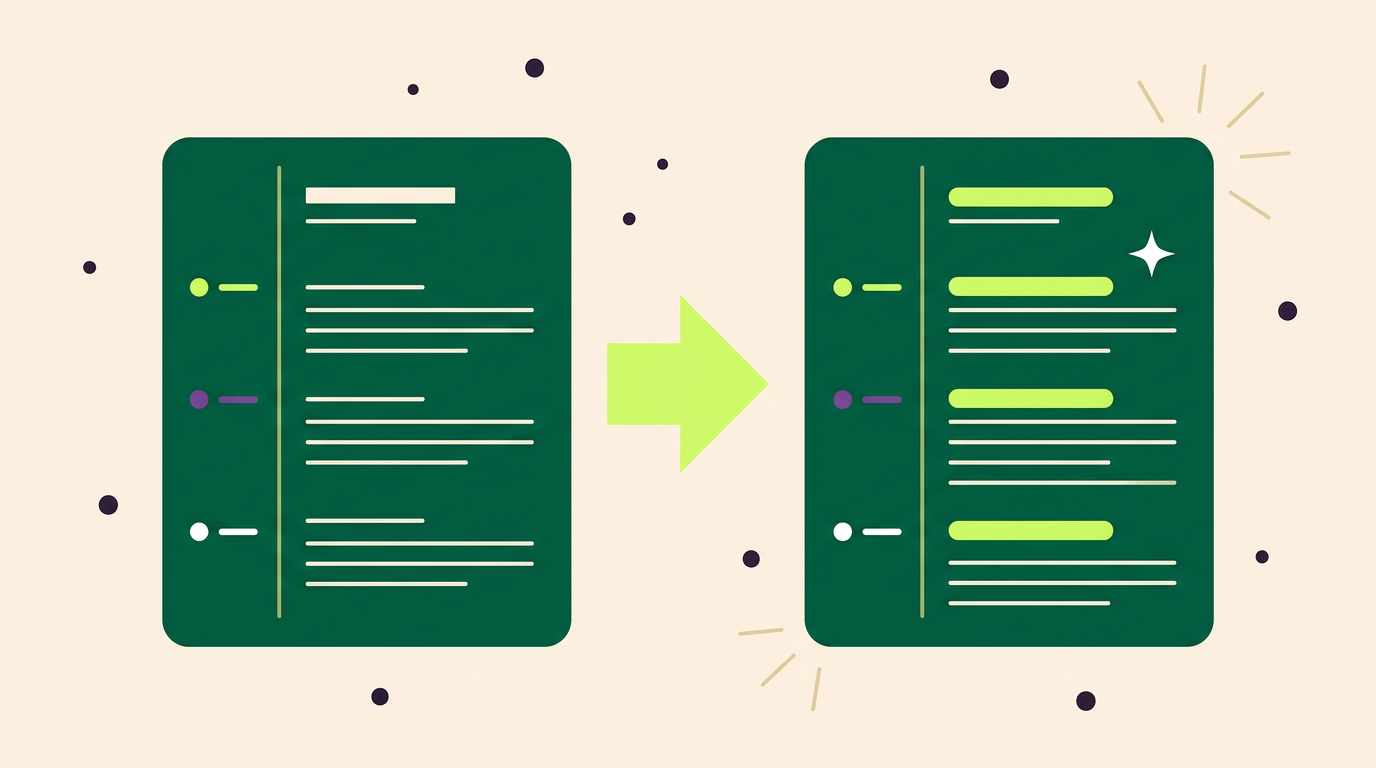
- Bullet point suggestions. AI that takes a rough description of what you did and suggests polished, quantified alternatives.
- ATS scoring. A pre-submission check that flags potential parsing issues before you apply.
At Prentus, our AI career agents help students build resumes tailored to specific job postings, turning academic projects and extracurricular work into compelling professional narratives. The goal is not to replace your voice but to amplify it.
The Bottom Line
Not having traditional work experience is not the disadvantage it feels like. Every recruiter hiring for entry-level roles knows they are evaluating potential, not track records. Your job is to make that potential as visible and concrete as possible. Frame your education as real experience, because it is. Quantify what you can. Make sure your formatting does not get in the way. And do not be afraid to use AI tools to polish the presentation.
The graduates who land interviews fastest are not necessarily the ones with the most impressive resumes. They are the ones whose resumes make it easy for a recruiter to say “yes, let us talk to this person.” Clarity and specificity will get you there.