

The STATS Rule and the Do No Harm Earnings Standard
One law, one rulemaking. The STATS final rule published July 1, 2026 takes effect July 1, 2027 and folds gainful employment and debt-to-earnings into a single earnings premium test for nearly every Title IV program.
Read the full STATS breakdown for the regulatory text and the calculation method.
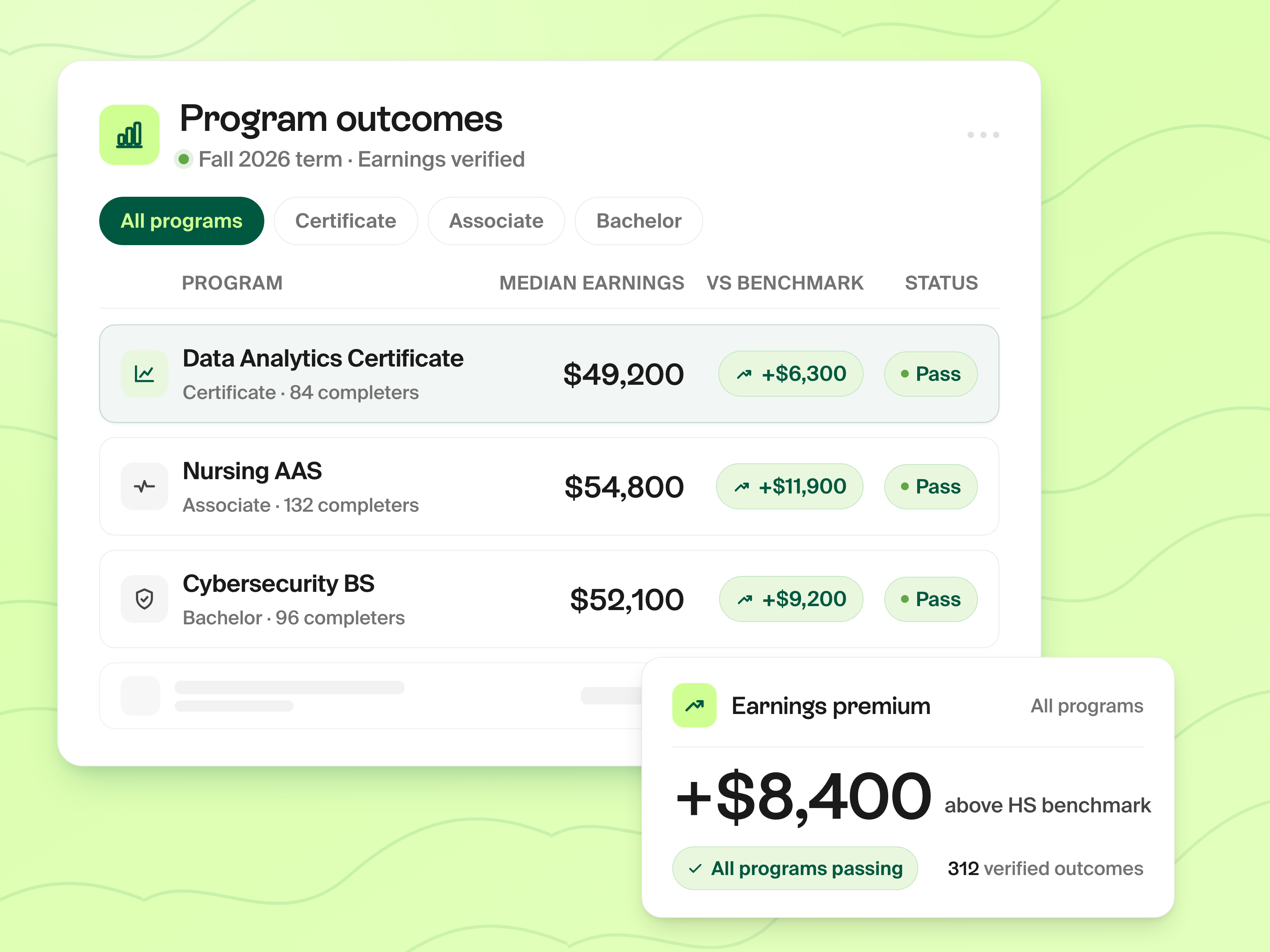
Quick answer
What is the Do No Harm standard?
The Do No Harm standard requires every Title IV program to prove its graduates out-earn a benchmark worker. Undergraduate programs are measured against adults aged 25 to 34 holding only a high school diploma, graduate programs against bachelor's holders. Fall below in two of any three award years and the program loses federal Direct Loan eligibility.
Last updated August 11, 2026. Every date and threshold on this page is sourced to the STATS final rule and the Department of Education announcement.
The dates that actually bind
Jul 4, 2025
The law creating the earnings accountability framework is signed
Jul 1, 2026
Statutory effective date, and the day the STATS final rule is published in the Federal Register
Aug 31, 2026
Amendatory instructions 13 and 14 take effect
Jul 1, 2027
The STATS rule takes effect and programs are measured on the earnings premium
Docket ID ED-2026-OPE-0100, RIN 1840-AE06, 34 CFR Parts 600, 668, and 685. The rule's own DATES section reads “This rule is effective July 1, 2027, except for instructions 13 and 14, which are effective August 31, 2026.” July 1, 2026 is the statutory effective date Congress set, which is why you will see both years quoted. The Department also designated one early-implementation item for July 1, 2026, the elimination of the reduced institutional reporting provisions at 34 CFR 668.406. Programs preparing students for predominantly tipped occupations are delayed so the calculation can use tax years in which the No Tax on Tips policy applies, beginning with the 2026 tax year.
What Changed
STATS consolidates three regulations into one
The carve-outs that let most degree-granting programs avoid Gainful Employment are gone. Nearly every Title IV program is now in scope of the same accountability standard, effective July 1, 2027.
What STATS replaces
- FVTThe Financial Value Transparency framework retires. STATS takes over.
- DTEThe debt-to-earnings metric is eliminated. One Earnings Premium metric replaces it.
- GE scopeGainful Employment's narrow scope (non-degree at nonprofits, all at for-profits) expands to nearly all Title IV programs.
- ReportingProgram-level cost, enrollment, completion, and scholarship data submitted annually, alongside one final legacy GE/FVT cycle due October 1, 2026.
The Earnings Premium test
- ComparisonMedian graduate earnings vs. earnings threshold for non-graduates in the same state and program type.
- UndergradThreshold = median earnings of HS-diploma-only workers ages 25 to 34.
- GraduateThreshold = lowest median earnings of bachelor's-degree holders ages 25 to 34 by state + CIP.
- Data sourceEarnings as reported to the IRS, including self-employment income, measured four years after completion. Thresholds come from Census Bureau data.
- PenaltyBelow threshold 2 of 3 years = loss of Direct Loan eligibility; 3 straight years risks all Title IV aid.
Worth knowing. An appeal must be filed within 30 days of the notice of determination and may only argue that the Department erred in calculating the measure. The permitted grounds are the list of completers submitted, the earnings threshold applied, and the comparison of median earnings to that threshold. Institutions cannot appeal the methodology or the choice of comparison population. The Department expects roughly 1,000 programs to appeal each year. The only durable defense is clearing the threshold on the original measure.
The Mechanics
How the earnings test actually works
Two benchmarks, one measure, and a cohort rule that decides whose earnings count. This is the part most summaries skip.
| Element | Undergraduate programs | Graduate programs |
|---|---|---|
| Comparison population | Working adults aged 25 to 34 whose highest attainment is a high school diploma or recognized equivalent | Working adults aged 25 to 34 whose highest attainment is a baccalaureate degree |
| Geography | The state where the institution is located, or the national figure when fewer than 50 percent of enrolled students come from that state | Same state and national logic, plus field-of-study options at the two-digit or four-digit CIP level |
| Which threshold applies | One threshold. Undergraduate thresholds are not disaggregated by field of study | The lowest of the available medians, including the field-of-study figures, becomes the threshold |
| What is measured | Median annual earnings of recent completers, four years after completion, from data reported to the IRS | Median annual earnings of recent completers, four years after completion, from data reported to the IRS |
| Cohort period | Single year when 30 or more students completed. Below 30, the Department expands into earlier award years, then across the same four-digit CIP and credential level | Same cohort expansion rule |
| Result | Earnings premium is positive, zero, or negative. Zero or negative is a failing year | Earnings premium is positive, zero, or negative. Zero or negative is a failing year |
Definitions of earnings premium, earnings threshold, and cohort period as amended at 34 CFR 668.2 by the STATS final rule, 91 FR 40136, July 1, 2026. Earnings means wages, income as reported to the Internal Revenue Service, and other earned income including self-employment.
5.2%
Share of programs the Department estimates would fail the accountability framework
200,000+
Programs nationally that enroll Title IV students
~1,000
Programs the Department expects to appeal a determination each year
Department of Education estimates in the regulatory impact analysis of the STATS final rule, published July 1, 2026.
The Consequence Ladder
What a failing year actually costs
Loans and Pell move on different tracks. AI summaries routinely collapse the two, so here is the distinction that matters at a board table.
At the program level
- One failureThe institution must warn students that the program will lose Direct Loan eligibility, so they can transfer or stay with the risk in hand.
- Two of threeFailure in two of any three consecutive award years makes the program a low-earning outcome program under 34 CFR 668.603.
- The penaltyThe institution may not disburse Direct Loan funds to students enrolled in that program.
- How longEligibility cannot be reestablished for at least two years, and the period is indefinite until the institution requalifies the program.
- Orderly closureA failing program that is not yet a low-earning outcome program can keep loan participation for up to three years, or the normal program length, under an amended participation agreement that stops new enrollments.
At the institution level
- New standardThe rule adds an administrative capability requirement at 34 CFR 668.16(t).
- The testAt least half of the institution's Title IV recipients and at least half of its Title IV dollars must sit outside low-earning outcome programs.
- The stakeAn institution that stays below that line for two of three consecutive years can have Title IV eligibility terminated for those programs, and this is the only route by which Pell is lost.
- The exitAn institution can avoid the administrative capability penalty for a failing program that is not a low-earning outcome program by voluntarily blocking Direct Loan borrowing in it for at least five years.
- PellA program that fails the first earnings premium measure calculated and opts out of the loan programs can keep Pell Grant eligibility.
The short version. A failing program loses loans. An institution loses Pell only when the majority of its aid and its aided students sit inside failing programs. If you have seen a summary saying three straight failures strips Pell from a single program, that is the confusion this section exists to fix. See how these rules differ from gainful employment for the side-by-side comparison.
The Real Problem
IRS earnings data lags for years. Your team needs to know now.
The measure looks at earnings four years after completion, and the rule takes effect July 1, 2027. Put those together and the cohort being graded has been out of your building for years by the time the Department calculates the number. Schools that wait for the official metric give up every intervention window they had.
Prentus runs an automatic monthly LinkedIn scan backed by dozens of verification sources, with AI surfacing legitimate employment and salary matches for staff review, plus built-in surveys that catch what the scan misses, so institutional research and career services see the same outcome data at the same time, months before IRS records settle. The same data feeds STATS reporting submissions and gives your team a real early-warning view.
See the outcome tracking demoStudent completes program
Prentus starts tracking employment from day 1 after graduation, combining an automatic LinkedIn scan with built-in surveys so no staff campaign is required.
Automatic verification runs continuously
Detect employer name, title, start date, and salary range when available, on a rolling basis across LinkedIn and dozens of other sources.
Program-level dashboard
Institutional research, career services, and compliance all see the same median earnings figure by program, by cohort, by CIP code.
Reporting export, ready either way
Generate the October 1, 2026 legacy GE/FVT submission today, and the same export format carries forward once STATS reporting requirements are effective July 1, 2027.
Who STATS affects (everyone in Title IV)
The expansion is the point. GE-style accountability used to skip most degree programs. STATS does not.
Community Colleges
Certificate, workforce, and associate-degree programs are now graded on the same Earnings Premium metric. Programs with strong placement and modest tuition are fine; programs with weak placement and any meaningful tuition face the same scrutiny historically reserved for for-profits.
High urgency. Most programs now in scope.
Four-year universities
Degree programs that were exempt under Gainful Employment are not exempt under STATS. Bachelor's programs with weak field-of-study outcomes can now lose Direct Loan eligibility. Graduate programs face the bachelor's-degree-holder benchmark.
Major change. Carve-outs gone.
For-profit + career training
Familiar territory but a simplified standard. The debt-to-earnings calculation goes away. Only the Earnings Premium remains, applied uniformly. Programs already tracking placement carefully are positioned to weather it.
Medium urgency. Standard simplified.
Get a Free Outcomes Diagnosis
Bring your program-level placement and earnings numbers. Leave with a maturity assessment against the incoming STATS Earnings Premium test and a gap plan. 30 minutes, no sales pitch.
Get a Free Outcomes DiagnosisHow Prentus Helps
See your Earnings Premium before the IRS does
STATS general provisions are effective July 1, 2027, and the Department calculates Earnings Premium metrics from IRS data that lags real time by design. Prentus tracks the equivalent signal continuously so your team sees the trend well before the Department finalizes it.
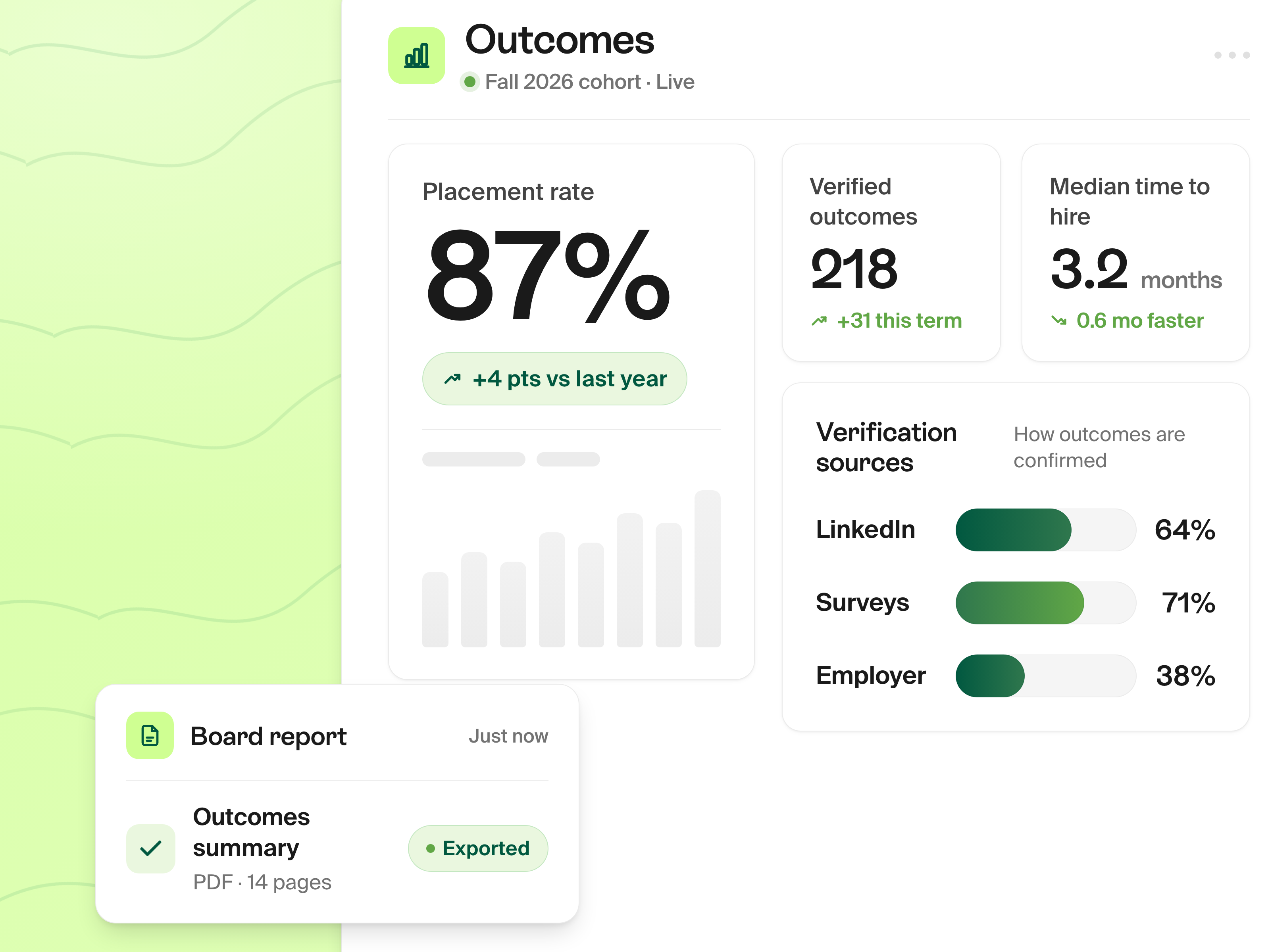
Program-level dashboards
STATS measures the Earnings Premium by program and six-digit CIP code. Prentus rolls outcome data up the same way, so institutional research and career services see one number in one place.
Reporting cycle ready
Tuition, fees, scholarships, enrollments, completions. Prentus generates the October 1, 2026 legacy GE/FVT submission, and the STATS reporting cycle after it, in one export instead of a fire drill across registrar, financial aid, and career services.

Intervene before failure
A program designated low-earning outcome loses Direct Loans for two years. Prentus flags programs trending below the Earnings Threshold so career services can act on the right cohort, not after the fact.
Wait for the IRS, or know now
✗ Wait for the IRS calculation
- ✗First Earnings Premium calculation lags years behind the graduating cohort
- ✗No early warning if a program is trending below threshold
- ✗Manual outcome surveys at 6 to 9 months produce 20 to 30 percent response rates
- ✗Career services and compliance operate from different data sets
- ✗Each October 1 reporting cycle turns into a fire drill
- ✗Appeals limited to calculation errors. No way to argue out of a designation
 Prentus continuous tracking
- ✓Automatic LinkedIn scans and dozens of verification sources detect employment continuously after graduation
- ✓Salary range and title detected automatically when public
- ✓Program-level dashboards by cohort and CIP code for early-warning
- ✓Institutional research, career services, and compliance see one number
- ✓Every October 1 reporting cycle generated from live data, not a year-end push
- ✓See your projected Earnings Premium position well before the IRS does
Between Now and July 2027
What institutions should do now
You cannot move the threshold and you cannot argue with IRS data. What you can change is how early you see the trend and how many students reach a job worth counting.
Rank your programs against the state benchmark before the Department does
Pull median earnings for your completers by program and credential level, then set them next to the state median for adults aged 25 to 34 with only a high school diploma. The programs sitting within a few thousand dollars of that line are the ones to plan around, not the ones already comfortably above it.
Fix the completer list, because that is the one input you control
The Department calculates the measure from the list of completers you report, and a completer list is also one of only three grounds for appeal. Program mapping, CIP codes, and exclusions all need to be right before the first measured cohort, not after a determination letter arrives.
Raise your knowledge rate on graduate outcomes
A once-a-year survey answered by a fifth of the class cannot tell you whether a program is trending toward a negative earnings premium. Continuous capture can. This is the same problem set out in our report on the first-destination data gap, and it is the foundation everything else on this page rests on.
Decide where career support gets integrated, not just offered
Earnings follow job quality, and job quality follows how early students engage. Look at where career work can actually live inside the institution you already run, on your program pages, inside orientation, in the classroom, and in the advising workflow, then pick the two or three integration points you can staff this year.
Give one person the number and a place to keep it
Institutional research, career services, and compliance should be reading the same program-level figure on the same day. When outcome data lives in one staff member's spreadsheet, it leaves when they do, and the July 2027 measurement will not wait for the handoff.
If you want help mapping those integration points, we run a 30-minute working session that looks at where career support can fit into the programs, orientation, and advising you already have, then hands you the plan. See what that session covers.
Sources
Every legal and numeric claim on this page traces to one of these. Last updated August 11, 2026.
- STATS final rule, 91 FR 40136, published July 1, 2026, effective July 1, 2027. Docket ID ED-2026-OPE-0100, RIN 1840-AE06
Source for the dates, the earnings threshold and cohort period definitions, the consequence ladder, the appeal grounds, and the failure and appeal estimates.
- U.S. Department of Education announcement of the final rule, June 29, 2026
Source for the undergraduate and graduate benchmark framing and the two-of-three-years trigger.
- Association for Institutional Research, program accountability reporting
Source for the October 1, 2026 legacy Financial Value Transparency and gainful employment reporting deadline covering the 2025 to 2026 award year.
Common Questions
STATS and Do No Harm FAQ
What is the Do No Harm standard?
Do No Harm is the earnings accountability standard created by the law signed July 4, 2025, and implemented by the Department of Education through the Student Tuition and Transparency System final rule. Undergraduate programs must show median graduate earnings above the median for working adults aged 25 to 34 with only a high school diploma. Graduate programs are measured against working adults aged 25 to 34 with only a bachelor's degree. A program that falls below its threshold in two of any three consecutive award years is designated a low-earning outcome program and loses Direct Loan eligibility.
When does the STATS rule take effect?
The final rule was published in the Federal Register on July 1, 2026 and is effective July 1, 2027, except for amendatory instructions 13 and 14, which are effective August 31, 2026. July 1, 2026 is the statutory effective date Congress set in the law, and the Department also designated one early-implementation item on that date, the elimination of the reduced institutional reporting provisions at 34 CFR 668.406. One final legacy gainful employment and Financial Value Transparency reporting cycle is due October 1, 2026.
Is the STATS Act a law or a regulation?
STATS is a regulation, not a separate act of Congress. It is the Student Tuition and Transparency System final rule at Docket ID ED-2026-OPE-0100, RIN 1840-AE06, which the Department issued to implement the earnings accountability provisions of the law signed July 4, 2025. There is no standalone STATS Act. Do No Harm and STATS come from the same law and the same rulemaking, which is why treating them as two separate requirements leads people wrong.
How is the earnings premium calculated under STATS?
The earnings premium is the amount by which median annual earnings of recent completers exceed the earnings threshold. Earnings are measured four years after completion from data reported to the IRS, and thresholds come from Census Bureau data. The Department uses a single-year cohort period when 30 or more students completed the program, and expands into earlier award years, then across the same four-digit CIP and credential level, when fewer than 30 completed. Undergraduate thresholds use the state where the institution sits, or the national figure when fewer than 50 percent of enrolled students come from that state.
What happens if a program fails the STATS earnings test?
After one failing year the institution must warn students that the program will lose Direct Loan eligibility. After failure in two of any three consecutive award years the program becomes a low-earning outcome program and cannot disburse Direct Loans, with a minimum two-year wait before eligibility can be reestablished. Pell Grant eligibility runs separately. A program loses Pell only where the institution fails the new administrative capability standard at 34 CFR 668.16(t), which requires that at least half of Title IV recipients and at least half of Title IV funds are not in low-earning outcome programs.
Can institutions appeal a low-earning outcome determination?
Yes, within 30 days of the notice of determination, and only on the basis of an error in the Department's calculation. The permitted grounds are the list of completers submitted, the earnings threshold applied, and the comparison of median earnings to that threshold. Institutions cannot appeal the methodology or the choice of comparison population. The Department estimates roughly 1,000 programs may appeal each year.
Get a Free Outcomes Diagnosis
Bring your program-level placement and earnings numbers to a 30-minute working session. Leave with a maturity assessment against the STATS Earnings Premium test and a gap plan. No sales pitch.
Get a Free Outcomes DiagnosisOr read the STATS breakdown, the first-destination data gap report, see Workforce Pell requirements, how gainful employment differs, or the full compliance hub. For compliance updates in your inbox weekly, subscribe to the Weekly Workforce Wire.