

In Texas, enrollment doesn’t pay. Outcomes do.
Texas community colleges are funded per outcome: credentials of value earned, transfers completed, dual credit finished. If your outcome tracking is manual, you're leaving money on the table.
Trusted by career teams at





Featured institution
DeVry University partners with Prentus to track graduate career outcomes at scale.
Across a nationwide campus network, Prentus helps DeVry's career services team verify where graduates land, what they earn, and which programs drive the strongest outcomes, the exact data required under outcomes-based funding models.

What Is Texas HB 8?
Texas House Bill 8, passed by the 88th Legislature and signed into law in June 2023, is the most significant change to community college funding in Texas history. It replaced the static, enrollment-based formula with a performance model that pays colleges directly for student outcomes.
Under HB 8, every Texas community college earns performance tier funding for each fundable outcome their students achieve: completing a Credential of Value, successfully transferring to a four-year institution with 15+ semester credit hours, or finishing a dual credit sequence as a high school student. The law was updated and expanded by Senate Bill 1786 in 2025.
The legislation affects all 50 Texas community college districts, from large urban systems like Dallas College to small rural institutions. For-profit and private institutions are not covered by HB 8, but all public community colleges in Texas are.
What Gets Funded
Three Fundable Outcomes Under HB 8
Your college earns a direct dollar amount for each. Weighted bonuses apply for Pell recipients, academically underprepared students, and adult learners (25+).
Credentials of Value (COV)
Certificates, associate degrees, and workforce credentials that meet THECB wage thresholds. FY 2025 baseline: $3,500 per credential. High-demand field credentials earn a premium.
Successful Transfers
Students who transfer to a Texas four-year public or private institution with at least 15 semester credit hours from your college. $3,500 per transfer in FY 2025.
Dual Credit Completions
High school students who complete a 15-semester credit hour dual credit sequence that applies to a postsecondary program. $3,500 per completion in FY 2025.
The Real Stakes
Why Outcome Tracking Directly Affects Your Budget
Miscounted outcomes = lost funding
If your CBM reports misclassify awards or fail to capture weighted funding eligibility for disadvantaged students, you're undercounting fundable outcomes and receiving less than you've earned.
Programs without wage data can't qualify as COV
Credentials need to demonstrate positive ROI above the median high school graduate wage. Without graduate earnings data, THECB can't verify your COV status.
The 3-year rolling formula punishes data gaps
Starting FY 2025, THECB uses the best of forecasted FY or a 3-year rolling average. If any prior year had undercounted outcomes, the average pulls your funding down.
Weighted funding requires accurate student classification
You earn 25-50% more per fundable outcome for Pell recipients, academically underprepared students, and adult learners. But only if you capture and report those classifications correctly.
Get a Free Outcomes Diagnosis
Bring your credential, transfer, and wage numbers. Leave with a maturity assessment against HB 8 and a gap plan for capturing every fundable outcome. 30 minutes, no sales pitch.
Get a Free Outcomes DiagnosisThe Prentus Approach
Automated Outcome Tracking for HB 8 Compliance
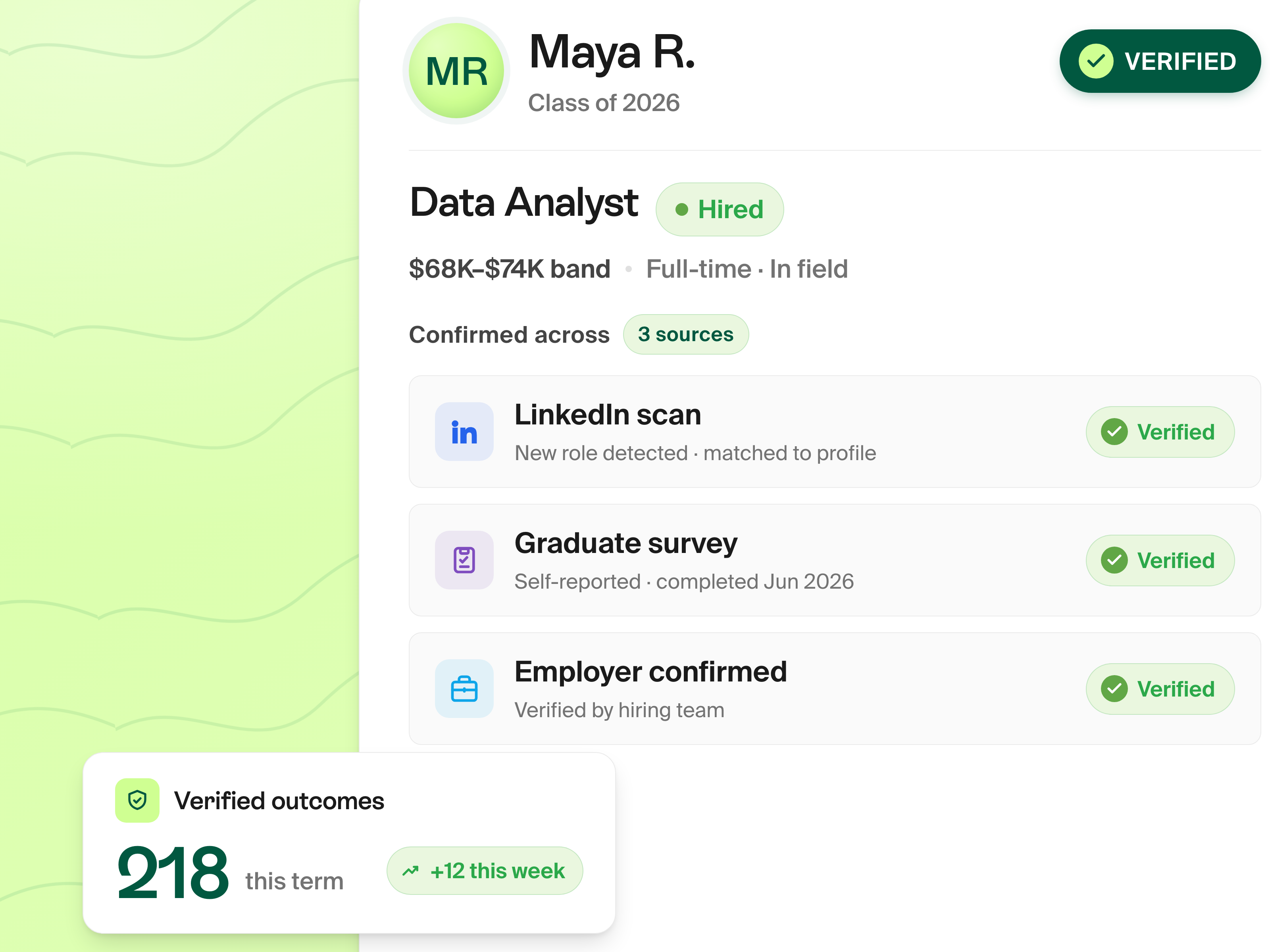
Career services teams can't manually survey thousands of graduates and also do their jobs. Prentus automates the tracking so outcome data is always current and always defensible.
LinkedIn Auto-Detection
Prentus automatically verifies graduate employment status and employer via LinkedIn, continuously. No survey campaigns, no chasing alumni.
Program-Level Wage Data
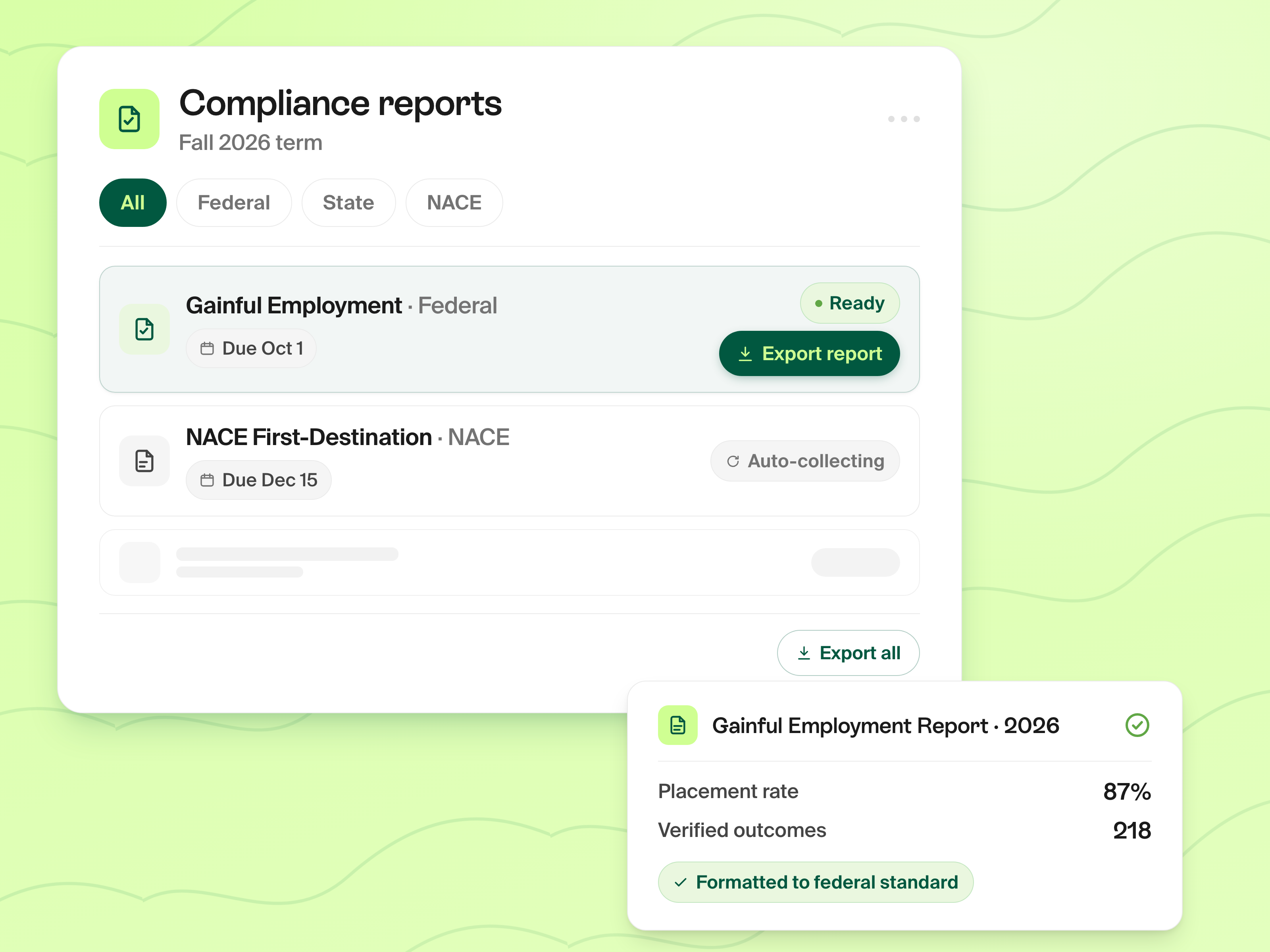
Export graduate earnings by program and credential type, the exact format needed to verify COV thresholds and support THECB reporting.
Multi-Program Dashboard
See outcome rates across every program at a glance. Spot which programs are close to COV thresholds, and which need attention before the next THECB review.
Cohort Tracking
Track the same student cohort over time, not just at the 6-month survey window. HB 8 rewards verified outcomes; Prentus provides continuous cohort visibility.
Capture verified graduate outcomes, not guesswork from 20% survey response rates.
The Old Way vs the Prentus Way
✗ Without Prentus
- ✗Annual graduate surveys with 15-25% response rates: not enough for THECB data
- ✗Staff manually compiling outcome data from SIS, financial aid, and alumni systems
- ✗No visibility into whether programs clear COV wage thresholds until THECB review
- ✗Missing weighted funding for Pell and underprepared students due to gaps in continuing ed records
- ✗Outcome reports take months to produce for board meetings
- ✗Risk of undercounting fundable outcomes and losing performance tier funding
 With Prentus
- ✓LinkedIn auto-detection tracks graduate employment continuously: no surveys
- ✓Outcome data organized by program, credential level, and cohort automatically
- ✓Real-time dashboard shows COV wage threshold proximity for every program
- ✓Verified earnings data supports THECB credential-of-value determinations
- ✓Board-ready outcome reports in minutes
- ✓Maximize performance tier funding by capturing every fundable outcome accurately
Free Resource
Texas HB 8 Outcomes Readiness Checklist
10 data capabilities your institution needs to maximize HB 8 performance funding.
Credential-Level Outcome Mapping
You can identify, for every program, whether the credential meets COV Baseline or Premium thresholds, including ROI above median high school graduate earnings.
Graduate Earnings Tracking
You track what graduates earn post-completion, at the program level, to verify whether credentials clear the wage thresholds required for COV designation.
Transfer Outcome Verification
You document which students transferred to a Texas four-year public or private institution with at least 15 SCH, the fundable transfer outcome under HB 8.
High-Demand Field Classification
You know which of your programs fall in THECB-designated high-demand fields, where additional performance funding applies.
Student Weight Eligibility Tracking
You capture Pell eligibility, academic preparedness, and student age (25+) for continuing education students, the criteria for weighted funding outcomes.
CBM Report Accuracy
Your CBM0CS, CBM009, and CBM00A reports correctly classify award levels, non-fundable awards, and course attempt counts, per FY 2025 and FY 2026 rule changes.
Multi-Credential Counting Rules
You apply the contact-hour sharing rule correctly: when a student earns multiple OSAs or ICLCs sharing contact hours in the same year, only one is counted for funding.
COV Premium Calculation
You calculate individual-level COV Premium status: time until positive ROI must be at least one year shorter than the median for that program and student cost profile.
Three-Year Rolling Average Readiness
Starting FY 2025, performance funding uses the best of: forecasted FY outcomes or a three-year rolling average of FY 2023-2025. Your data pipeline supports this.
Board-Ready Outcome Reports
You can produce program-level outcome reports (credentials earned, wages achieved, transfer rates) within days of a board request, not weeks.
Free Download
Get the Texas HB 8 Outcomes Readiness Checklist PDF
A 10-point guide to the data your community college must track to maximize HB 8 performance funding. Used by career services and institutional research teams across Texas.
Common Questions
Texas HB 8 FAQ
Does HB 8 apply to universities and four-year colleges?
No. HB 8 and the Texas community college finance model (updated by SB 1786 in 2025) applies specifically to public community college districts in Texas. General academic institutions at four-year universities operate under a separate formula funding model.
What happens if a program loses Credential of Value status?
Programs that no longer meet COV thresholds don't earn performance tier funding for completions in that credential. THECB publishes updated high-demand field lists and COV designations annually. Institutions need to monitor their programs against these thresholds continuously, not just at the start of each academic year.
How are industry certifications treated under HB 8?
Industry certifications are not directly fundable credentials under HB 8. They must be listed in the ACE National Guide with recommended semester credit hours to qualify. Third-party credentials like those on ACE-recognized Coursera programs can qualify if properly documented.
What's the difference between COV Baseline and COV Premium?
COV Baseline is a statewide determination: credentials that meet the minimum ROI and wage thresholds. COV Premium is calculated at the individual student level: if that student's time to positive ROI is at least one year shorter than the median for that credential, the college earns the premium rate. Premium status requires individual-level cost and earnings data.
Get a Free Outcomes Diagnosis
Bring your credential, transfer, and wage numbers to a 30-minute working session. Leave with a maturity assessment against HB 8 and a gap plan. No sales pitch.
Book 30-Minute DemoOr read the complete HB 8 explainer, or see how Texas compares to Florida's performance funding model. For compliance updates in your inbox weekly, subscribe to the Weekly Workforce Wire.