
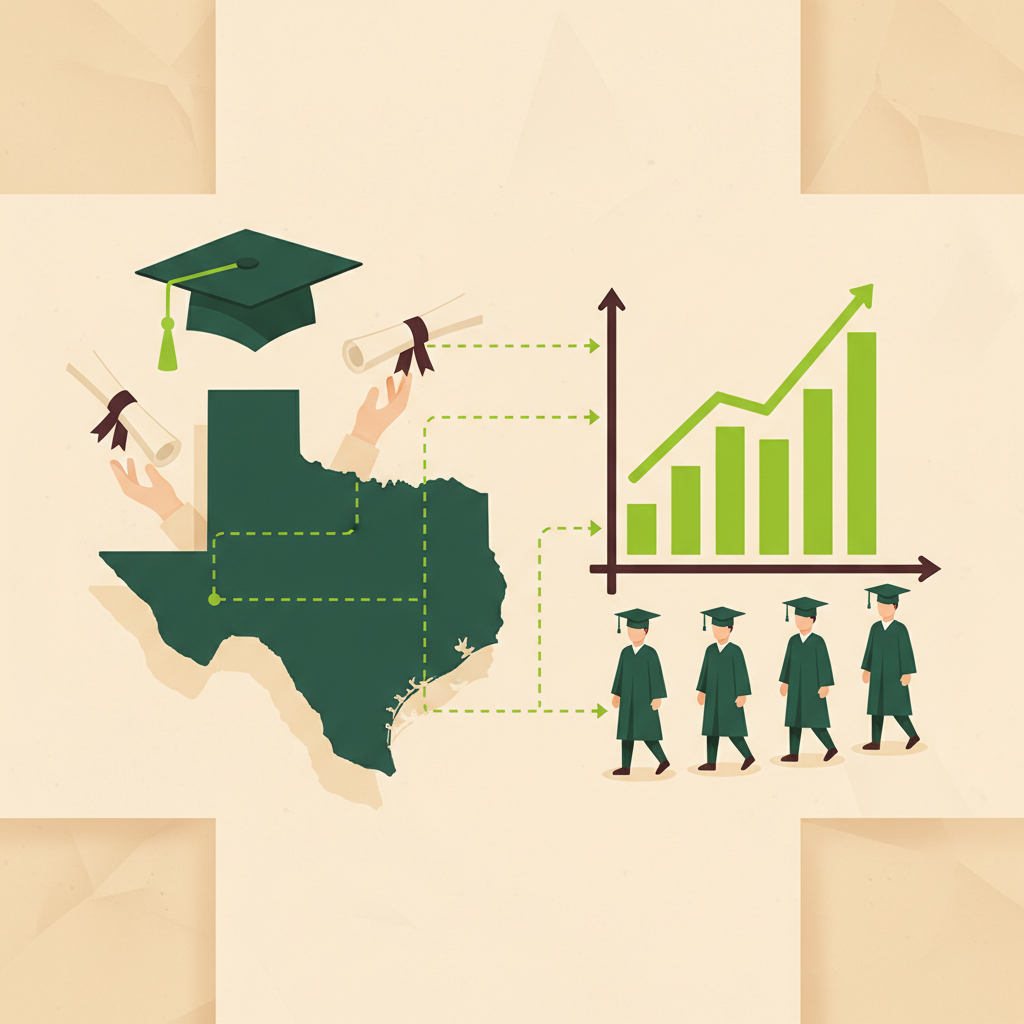
Texas community colleges don't get funded for enrolling students anymore. They get funded for what happens to students after they graduate.
That shift happened in June 2023 when Texas Governor Greg Abbott signed House Bill 8 into law. It took effect September 1, 2023 and fundamentally changed how all 50 Texas community college districts get paid. The question isn't whether this affects you. It does. The question is whether your institution has the data infrastructure to prove it's delivering on the outcomes that trigger your funding.
Texas HB 8 is the state law, signed in June 2023 and effective September 1, 2023, that replaced enrollment-based funding for all 50 Texas community college districts with an outcomes-based model. Colleges now get paid per fundable student outcome, including credentials of value, successful transfers to four-year universities, and dual credit completions, with Pell recipients and adult learners over 25 generating 25 to 50 percent more per outcome. A three-year rolling average of these outcomes began factoring into funding starting FY 2025, so data gaps from prior years directly reduce future state dollars. Programs must prove graduate earnings clear the return-on-investment threshold to count as credentials of value, which means colleges without wage verification risk misclassifying programs and leaving performance funding uncollected. Prentus gives community colleges the verified graduate employment and wage data needed to confirm credential of value status and capture the funding those outcomes are meant to generate.
Quick Summary
Texas HB 8 replaced enrollment-based funding for community colleges with an outcomes-based model that pays institutions per fundable student outcome: credentials of value (COV) earned, successful transfers to four-year universities, and dual credit completions. Colleges earn more per outcome for Pell recipients, academically underprepared students, and adult learners over 25. Without verified graduate employment and wage data, institutions cannot confirm COV status for their programs and risk leaving performance funding on the table.
Key Takeaways
- HB 8 is already law. It took effect September 1, 2023, not a future deadline.
- 50 institutions affected. All public Texas community college districts operate under this model.
- COV qualification requires wage data. Programs must prove graduate earnings clear the ROI threshold to count as Credentials of Value.
- Weighted funding rewards disadvantaged students. Pell recipients and adult learners generate 25-50% more per fundable outcome, but only if classified correctly.
- 3-year rolling average starts FY 2025. Past data gaps now directly reduce future funding calculations.
What Texas HB 8 actually changed
Before HB 8, Texas community colleges were funded primarily on contact hours and headcount. Show up, get paid. The problem with that model is obvious: a college could enroll thousands of students, collect tuition and state funding, and graduate many of them into credentials that don't actually help them get jobs or earn more than a high school graduate. The broader trend of community colleges positioning as the AI safe harbor makes this funding shift even more significant.
HB 8, passed by the 88th Legislature, flipped this. Texas now pays community colleges for what students accomplish, not just for their presence. The new performance model has three fundable outcome types, each with a fixed base funding amount per outcome in FY 2025 ($3,500 per fundable outcome). Weighted bonuses apply for specific student populations.
The law was expanded by Senate Bill 1786 in 2025, which refined definitions and extended several provisions. If your institution hasn't reviewed your reporting and tracking approach since SB 1786, you may be working from outdated requirements.
The three fundable outcomes under HB 8
1. Credentials of Value (COV)
A Credential of Value is the core of HB 8. It's a certificate, associate degree, or workforce credential that meets two economic thresholds defined by the Texas Higher Education Coordinating Board (THECB):
- Positive ROI: The credential must generate a return on investment above the median earnings of a high school graduate.
- Cost recovery: The full net cost of attendance, including opportunity cost, must be recoverable within a defined timeframe.
COV Baseline is determined at the statewide credential level by THECB. COV Premium is calculated at the individual student level: if that student's time to positive ROI is at least one year shorter than the median for that credential, the college earns the premium rate. Premium status requires individual-level cost and earnings data.
Credentials in THECB-designated high-demand fields earn additional performance funding on top of the base rate. High-demand fields are updated annually, so your classification needs to be reviewed every year, not just at program launch.
2. Successful transfers
A fundable transfer outcome is a student who leaves your institution and enrolls at a Texas four-year public or private university with at least 15 semester credit hours from your college. The transfer must be to a degree-granting institution. Community college to community college transfers do not count.
This outcome type requires active verification, not just a student self-report. Your institution needs confirmation that the student actually enrolled at a four-year institution and brought the required credit hours. Weak alumni tracking turns fundable outcomes into missed funding.
3. Dual credit completions
High school students who complete a 15-semester credit hour dual credit sequence that applies toward a postsecondary program generate a fundable outcome for the community college. This is only triggered when a full sequence is completed. Partial completions don't count.
The weighted funding most institutions are undercounting
HB 8 doesn't pay a flat rate per outcome. It pays more for outcomes achieved by specific student populations. The weighted multipliers apply to:
- Pell-eligible students: Graduates who received Pell Grant funding generate weighted outcome payments.
- Academically underprepared students: Students who entered requiring remedial coursework and achieved a fundable outcome earn a weighted rate.
- Adult learners 25+: Continuing education students 25 years or older who complete a fundable credential qualify for weighted funding.
The problem: these weights only apply if your institution correctly captures and reports the classification in your CBM reports to THECB. Gaps in financial aid data integration, inconsistent coding for continuing education students, or late data pulls after award terms end all translate directly into uncollected funding.
What happens when programs don't clear COV thresholds
If a program does not meet the COV wage thresholds, completions in that program do not generate performance funding. The college still trains and graduates students. It just doesn't get paid for the outcomes under HB 8.
THECB updates its COV designations and high-demand field lists annually. A program that qualified as a COV last year is not automatically a COV this year. Institutions that don't monitor these designations continuously will discover disqualified programs at budget time, not before.
There's also the three-year rolling average problem. Starting in FY 2025, THECB uses whichever is more favorable: the forecasted FY outcome count or a rolling average of FY 2023, 2024, and 2025. If your institution undercounted fundable outcomes in any of those years, the average is lower than it should be, and your current funding is reduced accordingly. Past data gaps compound over time.
What data your institution needs to track
Boil it down and HB 8 compliance requires four categories of ongoing data, all of which align with what institutions need for broader outcome tracking and compliance:
- Graduate employment and wages: Where graduates go after completing a credential, what they earn, and whether those wages clear the COV threshold above a high school graduate median.
- Transfer verification: Confirmed enrollment at a Texas four-year institution with 15+ semester credit hours. Not self-reported: confirmed.
- Student classification data: Pell eligibility, academic preparedness coding, and age status for adult learners, captured at the student level and matched to each fundable outcome.
- Program-level COV monitoring: Continuous tracking of whether each credential program still meets THECB wage thresholds and high-demand field classifications.
Most career services teams at Texas community colleges are at staffing ratios that make continuous graduate tracking impossible manually. A 1:500 advisor-to-student ratio cannot run ongoing employment verification for every graduate while also doing intake advising, job placement support, and employer relationship management. Something gets dropped. Under HB 8, what gets dropped has a direct dollar cost.
For VP of Academic Affairs, Provosts, and Career Services Leaders
If you can't verify where graduates land, HB 8 funding is already leaving your institution
Prentus automatically tracks graduate employment and wages at the program level. That means your COV qualification data, your THECB reporting, and your board-level outcome summaries are always current. Not assembled every June when it's too late to change anything.
See the full compliance planHow CBM reporting connects to your funding
THECB uses your CBM reports to calculate fundable outcomes. The three reports most directly affected by HB 8:
- CBM0CS: Credential completion records, including award type and award level classification. Misclassifying awards here means THECB can't properly count COV completions.
- CBM009: Student-level demographic data including financial aid status and academic preparation. This is where Pell and underprepared student weights live.
- CBM00A: Course-level data that affects how continuing education and dual credit sequences are counted.
The FY 2025 and FY 2026 rule updates to these reports added new requirements that older reporting setups often don't capture correctly. If your last CBM report review predates SB 1786, this is a gap worth auditing.
What institutions that get this right do differently
The Texas community colleges that are maximizing their HB 8 funding share four practices:
- They track graduates continuously, not just at survey time. Alumni employment data collected once a year is always behind. Real-time LinkedIn verification closes the gap between what happens and what gets reported.
- They monitor COV thresholds year-round. Not just when THECB publishes updated designations. Programs approaching the wage threshold get flagged before they lose status.
- They audit student demographic classification at the point of outcome, not after the fact. Catching a Pell coding error before CBM submission is fixable. Discovering it during a THECB audit is not.
- They use outcome data proactively, not just for compliance. Which programs are generating the most funded outcomes? Which populations are being underserved? This data informs program investment, not just reporting.
Outcomes funding rules keep shifting at the state and federal level. The Weekly Workforce Wire archive tracks compliance deadlines, performance funding changes, and labor market signals as they land.
Frequently asked questions about Texas HB 8
Does HB 8 apply to four-year universities in Texas?
No. HB 8 and the Texas community college performance finance model applies specifically to public community college districts. General academic institutions at four-year universities operate under a separate formula funding model. However, if you're at a four-year Texas public university, the federal OBBBA Do No Harm standard applies to you starting July 2026.
What happens if a program loses its Credential of Value designation?
Completions in programs that no longer meet COV thresholds don't generate performance funding under HB 8. The students still graduate, but the college doesn't get paid for those outcomes. THECB updates COV designations annually, so programs need to be monitored continuously, not just at the start of each academic year.
How are industry certifications treated under HB 8?
Industry certifications are not directly fundable credentials unless they are listed in the ACE National Guide with recommended semester credit hours. Third-party credentials that appear on ACE-recognized platforms can qualify if properly documented. Review your current industry certification offerings against the ACE list if you haven't recently.
What changed with Senate Bill 1786 in 2025?
SB 1786 expanded and refined several HB 8 provisions including updated COV definitions, clarifications to multi-credential counting rules, and adjustments to the CBM reporting requirements for FY 2025 and FY 2026. If your institution hasn't reviewed reporting practices since SB 1786 passed, that review is worth prioritizing before the next fiscal year submission.
For a detailed breakdown of the tracking requirements and a readiness checklist, see the Texas HB 8 compliance hub.