

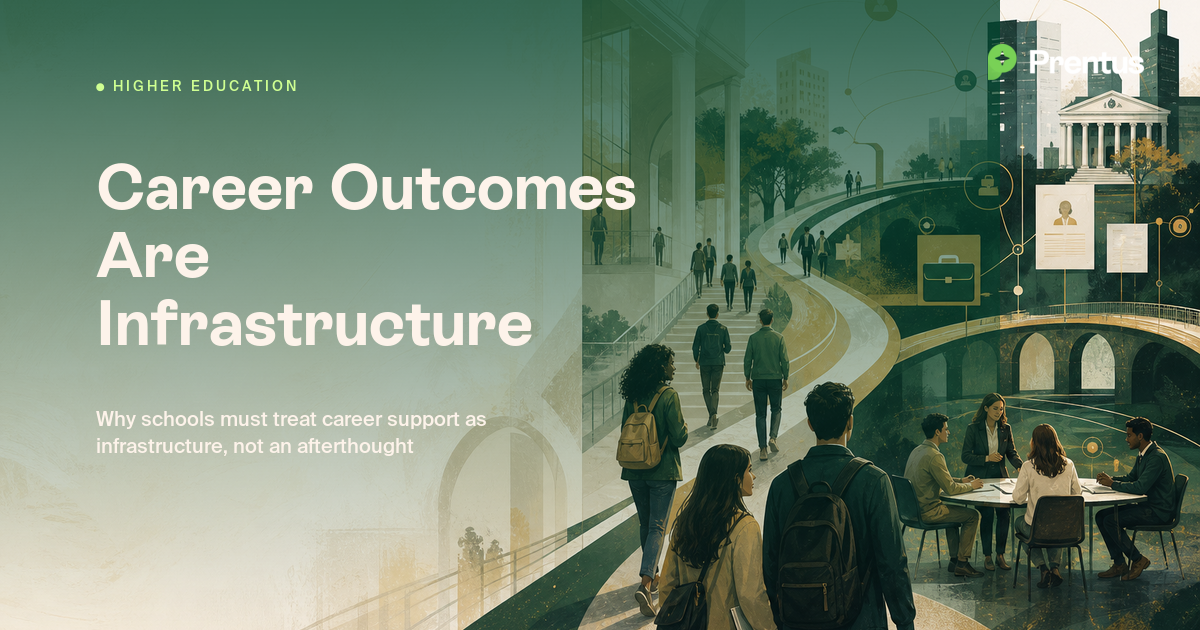
Career outcomes are not a nice-to-have anymore.
What are career outcomes as infrastructure?
Career outcomes as infrastructure is the principle that career support should be treated as a core institutional system embedded across the entire student lifecycle, not as an optional add-on service housed in one small office. This means dedicating real funding, staffing, and technology to career readiness from orientation through alumni engagement, the same way institutions invest in enrollment management, academic programs, and student housing. Schools that adopt this model build career exploration, skills translation, and employer connections into advising, curriculum, and work-based learning at every stage.
They are one of the main things higher ed needs to get right if it wants to survive the next chapter.
For years, a lot of schools treated career support like a side office. Small budget. Tiny team. Bad ratios. A few workshops. A resume review if a student happened to ask. That model was always shaky. Now it is a liability.
Quick Summary
If students mainly enroll to improve their job prospects, career outcomes cannot sit on the edge of the institution. They have to be built into advising, curriculum, employer access, and work-based learning from day one. Schools that understand this are already investing. Schools that do not are going to feel it in enrollment, outcomes, and compliance pressure.
The student expectation is not subtle. According to UCLA's Higher Education Research Institute, 87.9% of incoming freshmen said being able to get a better job was a very important reason for going to college. When that is the core expectation, career outcomes should show up in budgets, board meetings, and strategic plans.
Some schools are already making the shift
You can see the market waking up. Dartmouth raised $30 million to expand internship access. CUNY SPS has pushed career-infused degree maps that connect coursework to career direction. Pratt launched a $5 million endowed internship fund. The University of Cincinnati put $5 million into paid internships, co-ops, and career support.
That is the right direction. But the bigger move is not just writing a bigger check. It is rethinking the whole student journey.
The real work is operational
From day one, are students exploring careers? Do they understand how classes connect to jobs? Are alumni and employers part of the experience early enough to matter? Are resume, interview, and networking skills built into the curriculum every semester? Are students graduating with real work on their resume instead of just course credits?
This is where most institutions still move too slowly. The instinct is to treat career support as optional or to keep it isolated from academics. But if the answer to those questions is no, the school is not preparing students for the outcome they came for.
What schools should audit right now
- Career exploration in the first semester, not the final year
- Clear links between coursework, skills, and actual jobs
- Alumni and employer exposure early enough to shape decisions
- Repeated practice with resumes, interviews, and networking
- Work-based learning, micro-internships, projects, or co-ops before graduation
The next six months matter
The schools that move now will have a real story to tell on student outcomes. The ones that do not will get exposed. Students are asking harder questions. Parents are asking harder questions. Regulators are asking harder questions too, and states like Florida are already tying hundreds of millions in funding to graduate employment outcomes. If you do not already know your own numbers, run a free outcomes scan on your last graduating class before someone else asks first.
Career outcomes are infrastructure now. Not a side office. Not a brochure bullet. Infrastructure. Gallup's 2026 confidence survey shows why: cost and weak job outcomes, not politics, are the biggest drivers of public distrust in higher ed.
For Career Services and Higher Ed Leaders
If career outcomes are the product, the student journey has to reflect it.
Prentus helps schools build career support students actually use, from exploration and advising to interview prep and work-based learning.