
Quick Summary
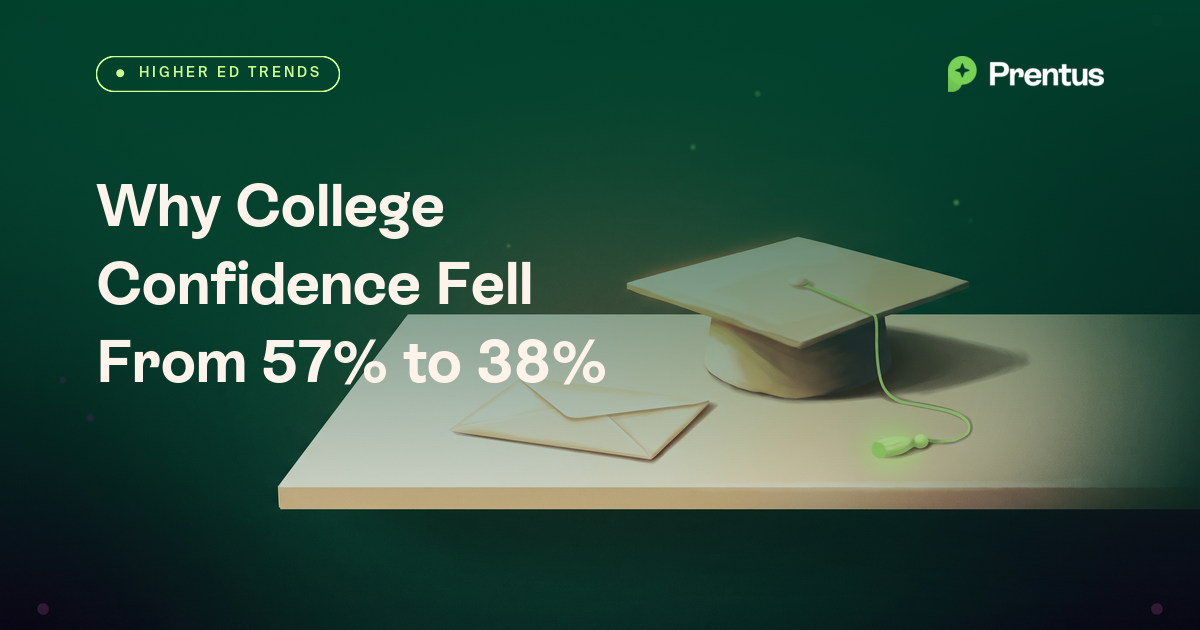
Gallup and the Lumina Foundation's 2026 survey puts confidence in higher education at 38%, down from 57% in 2015. Colleges have spent a decade fighting a political war. Cost and poor workforce preparation account for 55% of the reasons people gave for losing confidence, nearly double the 31% who blame political agendas. The people who still believe in college barely mention jobs either. Layer in a new finding that 46% of Americans expect AI to shrink the value of a degree, plus a federal rule that now demands program-level earnings proof, and the picture stops being subtle. Institutions won the argument that was never costing them the most students.
I talk to college leaders every week. Almost all of them think their confidence problem is a political one.
That is the comfortable read. A political problem lets a president blame the culture war instead of the balance sheet. Gallup and the Lumina Foundation just published their 2026 confidence survey, and the numbers do not support that read. Everyone is diagnosing the wrong disease.
What does the Gallup survey say about college confidence?
Gallup and the Lumina Foundation's 2026 survey found that only 38% of Americans have a great deal or quite a lot of confidence in higher education, down from 57% in 2015. Among people who lost confidence, 31% blamed political agendas on campus, but cost (30%) and poor workforce preparation (25%) combine for 55%, nearly double the political explanation.
The Numbers Behind the Panic
Confidence in higher education sits at 38% this year. In 2015, it was 57%. That is not a dip. That is a generation losing faith in an institution most of them still send their kids to.
The people who say they have very little or no confidence in college tripled over the same period, from 10% to 25%. One in four Americans now actively distrusts the system.
And this is not a one-party story, even though every campus strategic plan treats it like one. Democrats hit a new low this year at 50%, down from 61% a year ago and roughly 68% in 2015. Independents sit at 39%. Republicans at 23%. Every single group is lower than it was in 2015.
If this were purely political, one side would be holding steady while the other collapses. Instead, everyone is falling at the same time. That is the headline. Most boards still are not treating it as one.
Colleges Are Fighting the Wrong War
Gallup asked people why their confidence dropped, and politics was on the list. It was not the biggest reason. It was not even close.
31% of people who lost confidence pointed to political agendas on campus. That is real. It is also the war higher ed already lost, and the one every task force keeps re-fighting anyway.
Look at the other two reasons. 30% said cost. 25% said schools are not preparing students for the workforce. Add those together and you get 55%, nearly double the political explanation, and it is the war nobody on campus wants to have.
Why People Say They Lost Confidence
- 31% cite political agendas on campus.
- 30% cite the cost of a college education.
- 25% cite schools not preparing students for the workforce.
The majority complaint is not ideological. It is economic. Families are not walking away because college leans one way or another. They are walking away because it costs a fortune and does not reliably lead anywhere, while presidents spend their strategic-planning hours on the fight that is not the one costing them the most students.
The Defenders Gave the Game Away
It is not the skeptics who give away the real story. It is the believers.
Gallup also asked the people who still have confidence in higher ed why. The top answer, at 33%, was that college builds critical thinking and skills. Second, at 30%, was that it produces informed, engaged citizens.
Better job opportunities came in at 19%. Dead last among the reasons people gave for still believing in the system.
The people most likely to defend college, the ones you would expect to lead with “it gets you a job,” barely mention jobs at all. If college's own defense witnesses will not testify to the career outcome, that is not a messaging problem. That is the verdict.
The Stat Nobody Is Talking About Yet
There is one more finding in this survey that reframes everything above it, and it has not gotten much attention yet.
For the first time, Gallup asked Americans what they think AI will do to the value of a college degree over the next five years. 46% said it will matter less. Only 20% said more.
That is not a subplot. That is the anxiety underneath everything else in this data. People are not just worried that college is expensive and does not guarantee a job today. They are increasingly convinced the credential itself is losing ground to a machine that can already do parts of the job.
Students never stopped believing in education. They stopped believing it leads to a job, and now they are watching AI make that gap wider, not narrower.
Put the pieces together and the thesis is not complicated.
Federal Law Just Made This a Compliance Problem Too
While public opinion was drifting, federal policy caught up to it. The One Big Beautiful Bill Act, in effect since July 2026, requires institutions to prove graduate earnings program by program or risk losing federal funding.
Read that next to the Gallup data and it stops looking like a coincidence. Public trust and federal law are now asking the exact same question: where do your graduates actually land, and can you prove it?
Most schools still cannot answer that with real numbers. The typical career services office runs on roughly one advisor for every 1,900 students, according to NACE. That ratio was already too thin to track outcomes by hand before a law required program-level proof. Treating career outcomes as infrastructure, not an afterthought, is how a school answers both problems with the same system instead of two separate task forces.
Every Degree Should Lead to a Job
That is the whole argument, really. Not “college is broken.” Not “students do not value education.” Just this: every degree should lead to a job, and right now most institutions cannot show it does. If your strategic plan's biggest risk section says “political headwinds,” you are planning for the wrong decade.
The schools that figure out how to prove their outcomes, at the program level, with real data, are going to win the next decade. Not because they market better. Because they will be the only ones who can answer the question Gallup respondents and federal regulators are both asking directly, while everyone else is still fighting a war families already stopped watching.
Update, October 2026: the follow-up Gallup-Lumina employer survey found 60% of hiring managers have high confidence in higher ed, far above the public's 38%. We break down why employers trust college more than families do.